01 · Coir pith, coir fiber and husk chips: three products from one husk.
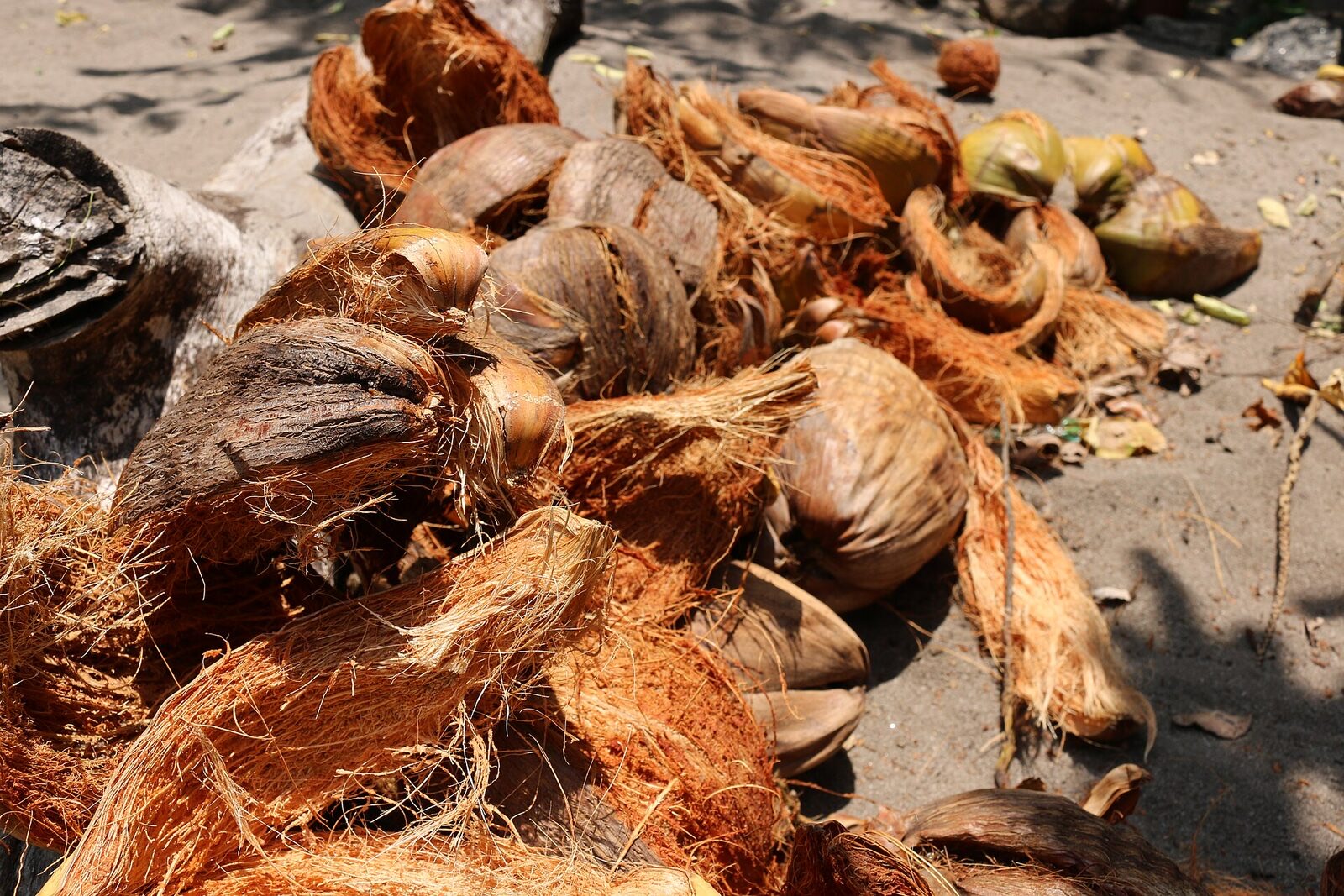
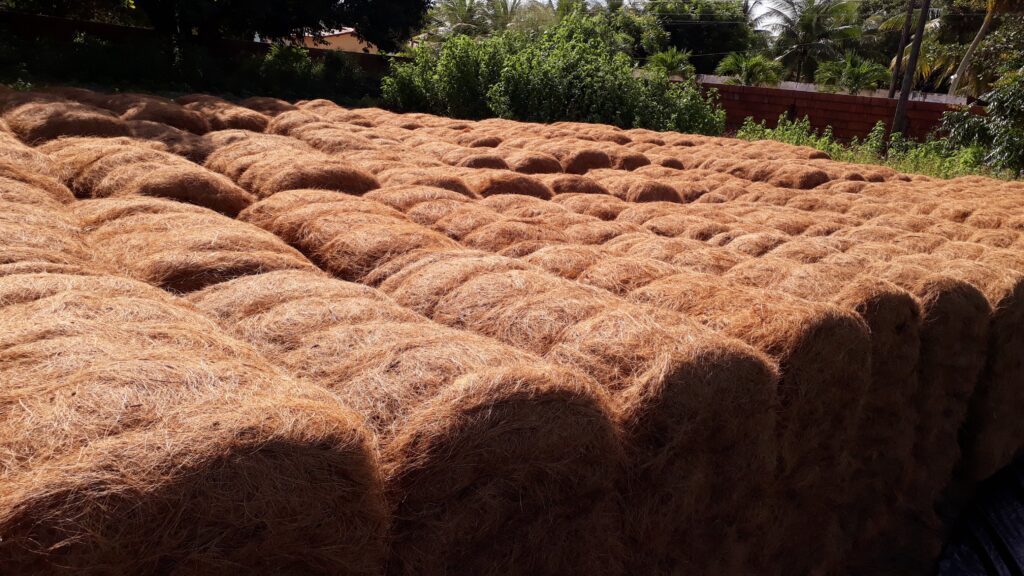
The coconut husk, the mesocarp of the fruit of Cocos nucifera, is made of long, stiff fibers held in a fine, spongy material. When dry husk is shredded and screened, two fractions separate: long fiber, about 30 % of the dry mass, and coir pith, about 70 %.[1] In Brazil the fine fraction is sold as pó de coco or substrato de fibra de coco; in export catalogues the same material is listed as coir pith, coco peat or cocopeat, and buyers also call it coco coir. In the Brazilian coir market all of these names refer to one product, which in international trade is nearly always shipped as compressed 5 kg blocks (coco peat blocks). Husk chips (coco husk chips) are a third product, obtained differently: the whole husk is cut into 10 to 20 mm pieces before any separation.
The three have different uses. Coir pith holds 8 to 10 times its own weight in water, has total porosity above 94 % and does not compact over the crop cycle, which makes it a growing medium for seedlings, protected vegetables and semi-hydroponic strawberries.[2] Long coir fiber, the coconut fiber of the rope and mattress trade, goes into structural substrates for ornamentals, erosion-control blankets and geotextiles for slope protection, mattresses and automotive composites. Husk chips are used for orchids, blueberries and drainage layers, and last 8 to 10 years in the pot, against 1.5 to 2 years for fine pith.[3] Carve's specifications for each product are on the coir pith, coir fiber and husk chips pages.
"The pith of dry coconut husk shows total porosity above 94 % and a water-holding capacity of 8 to 10 times its dry weight."EMBRAPA Tabuleiros Costeiros, Comunicado Técnico 226, on dry coconut husk from Northeast Brazil (translated from Portuguese)
02 · Coconut production in Brazil: concentrated in Ceará.
Brazil is the fourth- or fifth-largest coconut producer in the world, and the crop supports more than 700,000 direct jobs.[4] The national harvest of coco-da-baía, the dry coconut, was 2,105,345 tonnes in 2024, on about 187,000 hectares harvested, according to IBGE's Produção Agrícola Municipal.[5] Production is concentrated in the Northeast and in Pará. Ceará has been the largest producing state since 2020: 588,500 tonnes in 2024, up 13.4 % on 2023 and 28 % of the national total, ahead of Bahia (about 360,000 t), Sergipe, Pará and Pernambuco.[5]
At municipal level, Paraipaba, on the west coast of Ceará, produced 155,899 tonnes in 2024 and moved to second place in the country, behind Petrolândia in Pernambuco; coconut accounts for about a fifth of the municipality's GDP.[6] The Curu-Paraipaba irrigated perimeter is where the dry-coconut farms whose husk supplies Carve are located.


One detail matters for the growing medium: in Brazil, unlike in India and Sri Lanka, dry coconut husk is not retted, that is, not soaked for weeks in brackish lagoons. It is removed at the dehusking machine or at the copra plant and stored dry, often in the open for months, where rain washes out part of the salts. Brazilian cocopeat therefore starts from a lower electrical conductivity than raw Asian pith and needs fewer washing cycles to reach the limits nurseries and vegetable growers require.[7] A side-by-side comparison of the two origins on salt, harvest timing and lead time is on the Brazilian coir vs Asian coir page.

03 · Who produces coir pith and coir fiber in Brazil.
Despite the coconut output, the husk-processing industry is small and regional. The processors that sell pith and fiber at commercial scale are few, and none publishes audited production volumes. For an importer looking for a cocopeat supplier in Brazil, the practical consequence is a short supplier base in which each exporter has to be qualified individually.
| Supplier type | Where | What it offers | Source |
|---|---|---|---|
| Regional processors of dry coconut husk | Pará, Bahia, Ceará | Pith (granular), fiber and, in some cases, chips; generally tied to a single farm or copra plant; ship wet; operate without inventory and with a waiting list | Public interviews with producers, 2026 |
| Carve Biorrefinaria | Paraipaba, Ceará | Fine coir pith and coir fiber from dry husk that is not retted; Natural, washed and buffered grades; EC, pH, moisture, density and particle-size report per lot; export through the Port of Pecém | carvebio.com.br |
| Small processors | Coast of Ceará and elsewhere | Pith and fiber without grading or lab report, sold to larger blenders | Market survey |
No Brazilian producer publishes audited production volumes.
Above the processors sit the substrate blenders, concentrated in São Paulo and the South, which buy pith and fiber as inputs and sell ready mixes. The segment leader has announced a new R$ 100 to 150 million plant for 2027, with a 100 % coir line.[8] A relevant share of these blenders' demand is met by imports, as section 06 shows.
04 · The substrate market: R$ 517 million and 750,000 m³.
ABISOLO, the association of the special-fertiliser and substrate industry, recorded revenue of R$ 390 million in 2023 and R$ 517.2 million in 2025 for plant substrates, up 22.8 % on the year; the 2024 value, approximately R$ 421 million, is derived from that growth rate and was not published as such. Volume sold in 2024 was about 750,000 m³.[9] The 2025 jump was, in the association's own words, growth in price more than in volume, caused by the scarcity and rising cost of imported peat and perlite. By region, the Southeast accounts for 53.5 % of sales, the South 23.2 % and the Northeast 12.7 %.
By end use, ABISOLO splits the market into similar shares: forestry seedlings about 21 %, vegetables 20 %, fruit 16 %, coffee, citrus and sugarcane 16 %, flowers and ornamentals 15 % and tobacco 12 %.[9] Coir is not the only material in this market, which also uses composted pine bark, imported peat, vermiculite and perlite, but it is the fastest-growing component, because it replaces peat in mixes and because protected cultivation of vegetables and strawberries, which uses almost pure coco peat, is growing faster than the average.
05 · Demand by segment: where pith and fiber are used.
There is no official statistic for coir pith and fiber consumption in Brazil. The estimate below was built by Carve from public data for each segment (IBGE, IBÁ, Ibraflor, DNIT, Embrapa) and technical coefficients of substrate use per seedling or per hectare. It should be read as an order of magnitude.
| Segment | Product | Estimated consumption | Reference data (source) |
|---|---|---|---|
| Eucalyptus and pine seedlings | Pith | ~12,000 t/yr | 7.8 million ha of eucalyptus, ~1.5 billion seedlings/yr (IBÁ 2024) |
| Tobacco (South, excluded from the analysis) | Pith | ~10,500 t/yr | 720,000 t, 310,000 ha, 138,000 families (AFUBRA) |
| Semi-hydroponic strawberry | Buffered pith | ~9,500 t/yr | 336,000 t, ~6,500 ha, MG 55 %, ~45 % on substrate (IBGE) |
| Flowers and ornamentals | Pith, fiber, chips | ~9,000 t/yr | R$ 21.2 billion market, 8,300 growers, Holambra 45 % (Ibraflor 2024) |
| Erosion-control blankets and geotextiles | Fiber | ~6,500 t/yr | DNIT standard 074/2006 requires coir-fiber blankets on highway slopes; 1 t ≈ 3,000 m² |
| Semi-hydroponic tomato | Pith | ~4,500 t/yr | 4.7 million t, 63,000 ha; under 2,000 ha on substrate, growing >15 %/yr (IBGE) |
| Coffee seedlings | Pith | ~3,000 t/yr | ~300 million seedlings/yr; 2025 crop of 55.7 million bags |
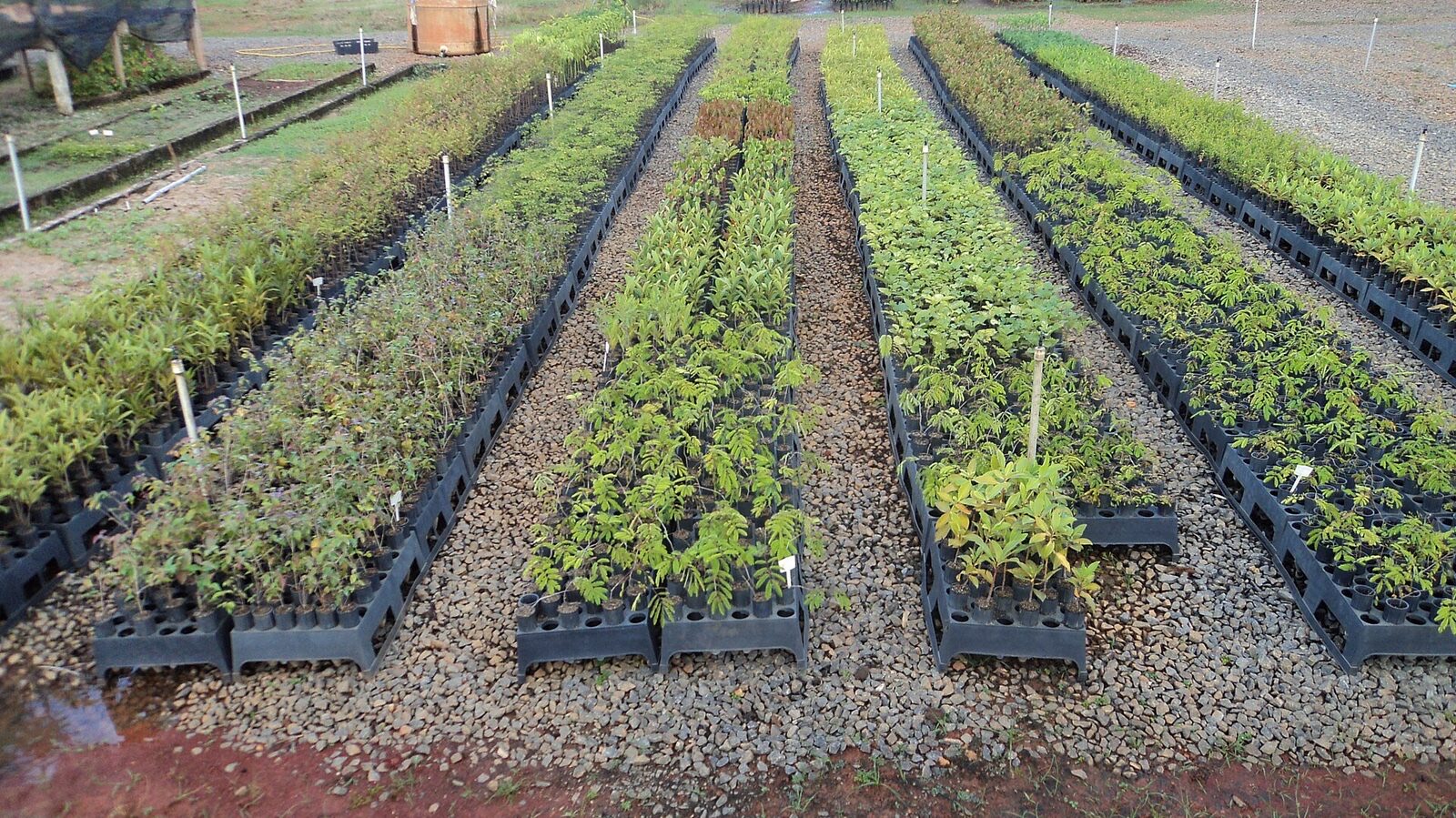
| Native-species restoration | Pith | ~2,700 t/yr | PLANAVEG: 12 million ha by 2030, 3.4 million done; 1,276 nurseries |
| Landscaping and mulch | Pith and fiber | ~2,500 t/yr | Carve estimate |
| Automotive and industrial | Fiber | ~1,500 t/yr | Artecola Ecofibra supplies Fiat, Jeep, Honda and Hyundai; parts 23 % lighter |
| Orchids and specialty crops | Chips and fiber | ~1,000 t/yr | 7.8 million pots/yr |
Estimated addressable total, excluding tobacco: about 56,000 t/yr, of which ~38,000 t of pith, ~10,000 t of fiber and ~1,000 t of chips. Carve estimate based on the data cited; not an official statistic.

Two segments deserve a note. The highway erosion-control blanket is the only demand for coir fiber imposed by a standard: DNIT 074/2006 specifies coir-fiber blankets for slope protection, which creates an industrial consumption of fiber independent of the substrate market.[11] And semi-hydroponic strawberry, concentrated in southern Minas Gerais, is today the largest buyer of buffered cocopeat in the country, a product no Brazilian processor manufactures and which arrives in imported slabs and bags. How each crop uses pith, fiber and chips is set out on the applications page.
06 · Imports and exports: Brazil exports raw fiber and imports substrate.
Trade data show a situation that is not intuitive. Brazil is the fourth-largest exporter in the world under tariff line NCM 5305 (coir fiber, raw or processed but not spun), with 5.8 % of world trade in 2024 and US$ 45.6 million in 2025, of which US$ 33.4 million went to China.[12] Almost all of that volume is raw coconut fiber, sold as raw material for rope, mattresses and composites; exports of processed cocopeat are negligible.
In the other direction, the country imported about US$ 5.4 million of processed coir substrate in 2025, 97 % from India, in the form of compressed blocks, grow slabs and buffered pith for strawberries and blueberries.[12] The largest domestic coir-substrate brand imported US$ 678,000 between May 2025 and April 2026 against US$ 20,000 exported.[13]
The explanation is the domestic market. Unlike India and Sri Lanka, which process husk to export, Brazil (like Mexico) has a domestic substrate market large enough to absorb the entire pith output of its few processors. Forestry nurseries, strawberry and tomato growers, flower growers and the erosion-blanket industry buy what exists, and product is still short: the largest domestic producer operates with a waiting list and no inventory, and blenders in São Paulo and Minas Gerais report difficulty finding a regular supplier of pith. What is left over is raw fiber, which goes to China, and what is missing are the formats nobody manufactures in the country: compressed 5 kg blocks and buffered pith, which keep coming from India.[14] For an importer, this is why Brazilian coir reaches the international market in small, allocated volumes; Carve's export terms through Pecém are on the international buyers page.
.jpg)
07 · Grades, electrical conductivity and how to buy coir pith from Brazil.
The parameter that defines the price and the use of coir pith is electrical conductivity (EC), measured in mS/cm on a 1:5 extract, which indicates the amount of soluble salts. Raw dry coconut husk has an EC between 0.4 and 6.0 mS/cm, depending on origin, husk age and exposure to rain.[2] From there the market works with three grades, which importers call natural, washed and buffered; a buyer asking for low-EC coco peat is asking for one of the last two:
| Grade | EC (1:5) | How it is achieved | Typical buyer |
|---|---|---|---|
| Natural (unwashed) | 0.4 – 6.0 raw; aged rain-fed husk ≤ ~1.5 | No treatment; provenance and time in the rain decide the number | Blenders that correct the mix, landscaping, salt-tolerant crops |
| Washed | < 1.0; professional < 0.7 | Two to five soak-and-drain cycles in fresh water, depending on starting salt | Nurseries, vegetable growers, premium-line blenders |
| Buffered | < 0.5, down to ~0.25 (RHP standard) | Washing followed by a calcium-nitrate soak, which displaces adsorbed potassium and sodium | Strawberry, blueberry, semi-hydroponic tomato and pepper, certified export |
Raw-husk range per EMBRAPA Comunicado Técnico 226. The RHP standard is the Dutch substrate certification required by part of the European buyers.
Beyond EC, the buyer should ask for moisture (with the basis stated, wet or dry, because the difference reaches 2.7 percentage points), pH (raw husk sits between 4.9 and 6.0), bulk density and particle size (screen mesh and share below 2 mm). In Brazil coir pith is traded by volume, in m³ or 100 L bags, not by tonne, because density varies with moisture and fineness: fine pith at 15–20 % moisture weighs about 90 to 95 kg per loose m³, but very fine or very wet pith can exceed 150 kg/m³ in the same volume.[15] Comparing quotes in R$/t without density and moisture basis produces errors of 30 to 70 %.
What the importer asks
In export the vocabulary changes: the product becomes coco peat in 5 kg blocks, EC is quoted as EC (1:5), expansion is measured in litres per block, and the buyer speaks of a FOB offer, D/P, phytosanitary certificate, fumigation, grow bags, slabs and RHP. The questions below were asked, in these words, by a Turkish importer of coco peat blocks in 2026; the answers describe general market practice.
"How many liters per 5 kg block?" Expansion is quoted in litres per kg; the market range is 13 to 16 L/kg, so a 5 kg block yields about 65 to 80 litres of loose coco peat once hydrated, and the importer usually asks for a photo of a block expanded in a trolley.
"Ec level should be less than 0.5" An EC (1:5) below 0.5 mS/cm is the buffered grade in the table above; washed blocks are usually specified below 0.7 or 1.0, and the extraction method (1:5 by volume) has to accompany the number.
"Could you make a FOB offer to us?" Coco peat is normally quoted FOB port of loading, per tonne or per container, with freight and insurance for the buyer's account; the buyer compares offers on landed cost at destination, not on the FOB figure alone.
"How would be the payment term?" Usual terms for a first shipment are an advance with the balance against a copy of the bill of lading, or D/P (documents against payment, documentary collection through the banks); a letter of credit is more common in larger contracts.
"I suppose you can load 22 pallets per container" A 40' HC container takes about 20 to 22 pallets of 5 kg blocks, somewhere between 20 and 26 tonnes net depending on pallet height and the road weight limit; pallets need ISPM-15 treatment, the phytosanitary certificate covers product and pallets, and some countries require fumigation on arrival.
"We can buy 2 containers per month" Regular importers buy on a monthly cadence of one to several containers, and they judge the supplier on consistent EC, moisture and expansion lot after lot, more than on a single sample.
08 · Brazil in the world coconut market.
India and Sri Lanka supply about 90 % of the coir fiber and pith traded in the world. India exported 1.34 million tonnes of coir products, worth US$ 434 million, to 121 countries in fiscal year 2024-25, and coir pith accounted for 60 % of that value.[16] Under HS 5305 (coir and other vegetable fibres, raw or processed but not spun), UN Comtrade records as the largest importers in 2025 the United States (82,100 t, against 87,600 t in 2024), the Netherlands (67,400 t), Spain (40,000 t), Canada (32,200 t), Germany (about 22,000 t) and Australia (18,900 t). Japan shows only 6,600 t because most of its coco peat enters under other tariff lines, and South Korea classifies the product outside HS 5305, with no reliable figure. The line also includes sisal and abaca, so the values are ceilings for coir.[17] The full picture of producers and importers is on the global coir market page.
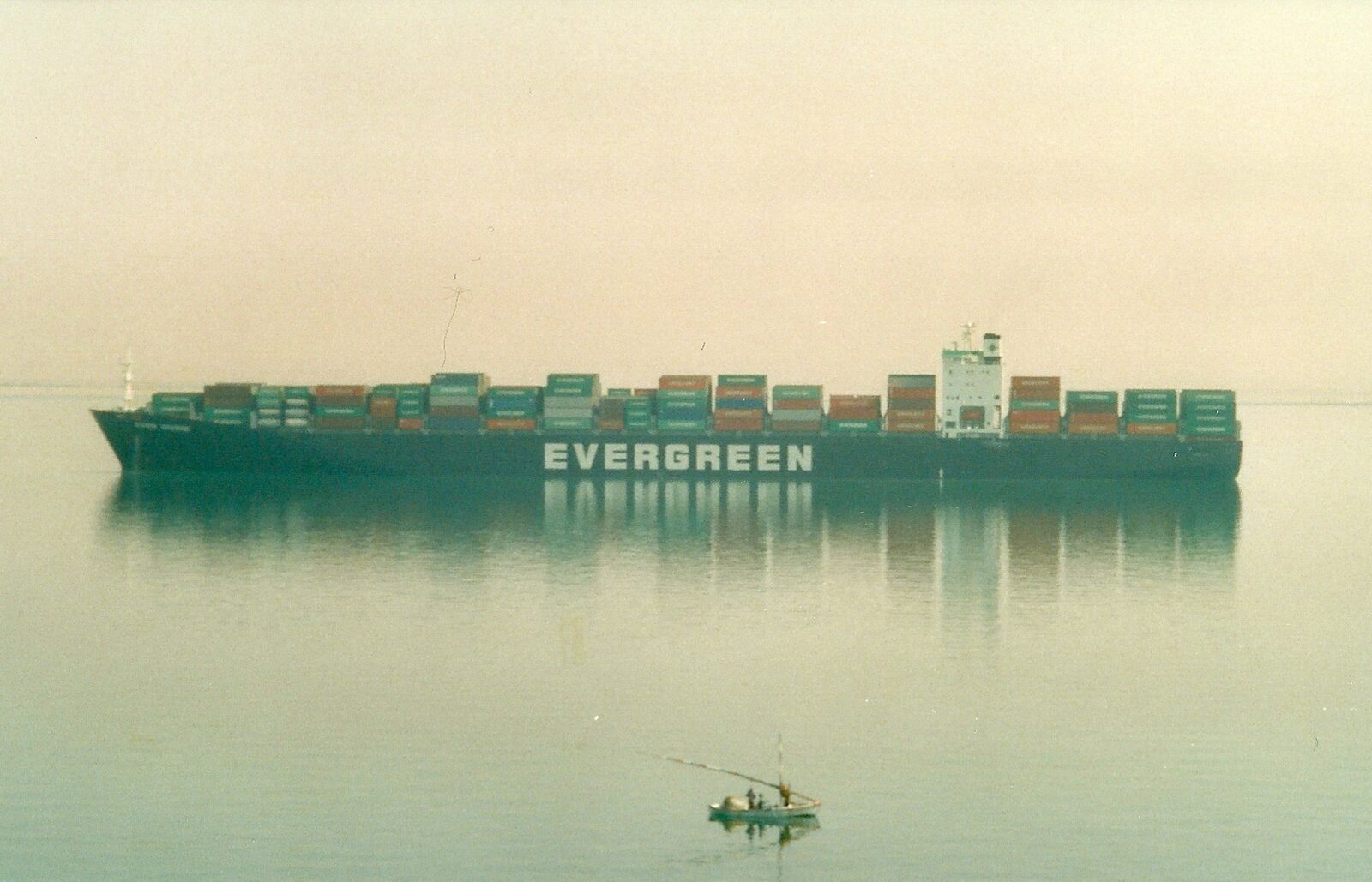
World demand is expected to grow. Wageningen University projects the growing-media market rising from 67 million m³ a year in 2017 to 283 million in 2050, with coir climbing from 11 to 46 million m³, and calculates that coir use must grow 180 % by 2030 for European substrates to reach 50 % renewable raw material.[18] At the same time, Asian supply faces the monsoon, ageing palms and, since 2023, the diversion of Asia–Europe routes around the Cape of Good Hope, which adds about 10 to 14 days per leg. In September 2026 the return to the Suez Canal is partial and service by service: some Maersk, Hapag-Lloyd, CMA CGM and MSC loops have resumed the route, but most India–Europe services still go around the Cape; transit from southern India to Rotterdam is about 35 to 45 days via the Cape and 22 to 28 days when the service passes through Suez.[19]
.jpg)
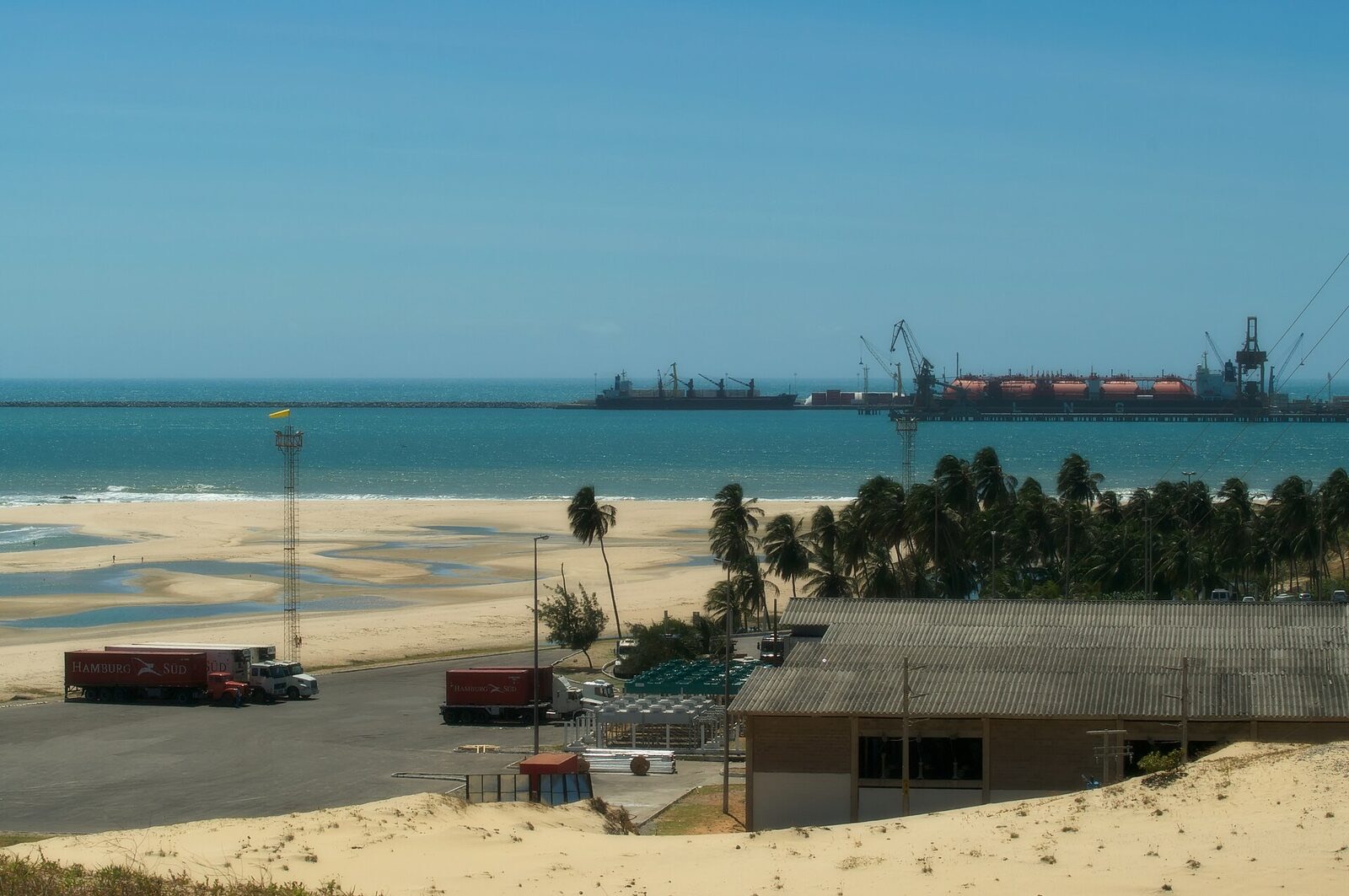
In this picture Brazil holds a particular position: it grows coconuts in large volume, does not ret the husk in salt water, has in Ceará a dry season from June to December, which coincides with India's south-west monsoon (June to September) and Tamil Nadu's north-east monsoon (October to December), and has a port, Pecém, from six days to Algeciras and New York, which handled 706,509 TEU in 2025, a record and a 27 % increase.[20] What is missing is processing capacity, and a domestic market that absorbs the little that is produced. The global coir market page details the international market; the international buyers page describes Carve's specification and logistics through Pecém.
Regional buyer perspectives
For regional buyer perspectives, see our market reports: United States, Turkey, Peru and Holambra. Each report covers market size, buyer segments, logistics from Pecem and trade terms for that destination.
09 · Frequently asked questions.
Who produces coir pith and coir fiber in Brazil?
Dry coconut husk is processed by a small number of regional processors in Pará, Bahia and Ceará. Carve Biorrefinaria (Paraipaba, Ceará) processes dry husk that is not retted into fine coir pith and long fiber, with a report per lot, for substrate blenders, nurseries and export through the Port of Pecém. Above the processors sit the substrate blenders, which buy pith and fiber as inputs for ready mixes.
Which Brazilian state produces the most coconuts?
Ceará, with 588,500 tonnes in 2024 (+13.4 %), followed by Bahia (about 360,000 t), Sergipe, Pará and Pernambuco, according to IBGE's Produção Agrícola Municipal. Brazil harvested 2,105,345 t of coco-da-baía in 2024. Paraipaba, Ceará, produced 155,899 tonnes in 2024 and is the second-largest producing municipality in the country.
What is the difference between coir pith, coir fiber and husk chips?
All three come from the coconut husk. Coir pith, also sold as cocopeat or coco peat, is the fine, spongy fraction, about 70 % of husk mass, used as a growing medium. Coir fiber (coconut fiber) is the long, stiff fraction, about 30 %, used in substrates, erosion-control blankets, mattresses and composites. Husk chips are 10 to 20 mm pieces cut from the whole husk, used for orchids, blueberries and drainage.
How big is the substrate market in Brazil?
According to ABISOLO, R$ 517.2 million in 2025 (+22.8 %), against approximately R$ 421 million in 2024 (a value derived from the growth rate) and R$ 390 million in 2023, with about 750,000 m³ sold in 2024. The 2025 growth was driven by price, because of the scarcity of imported peat and perlite.
Does Brazil import or export coir fiber?
Both. It is the fourth-largest exporter of raw coir fiber in the world (NCM 5305), with US$ 45.6 million in 2025, of which US$ 33.4 million went to China, and it imports about US$ 5.4 million a year of processed coir substrate, 97 % from India, because no domestic producer manufactures compressed 5 kg blocks or buffered pith.
How is coir pith bought in Brazil: by weight or by volume?
By volume, in m³ or 100-litre bags, because density varies with moisture and particle size. Fine pith at 15–20 % moisture weighs about 90 to 95 kg per loose m³ (EMBRAPA). Comparing prices per tonne without density and moisture basis leads to errors of 30 to 70 %.
Does coir pith need to be washed?
It depends on the use. Blenders that correct the mix and landscaping use natural pith. Nurseries and vegetable growers ask for EC below 1.0 or 0.7 mS/cm, obtained by washing in fresh water. Strawberries, blueberries and salt-sensitive crops ask for buffered pith, with EC below 0.5 and a calcium treatment. In every case, EC should be measured and reported per lot.
10 · Sources.
- FAO, Technical Paper 6, coir processing; Embrapa Agroindústria Tropical, Comunicado Técnico 54 and Documentos 52 (structural composition of the husk, 30/70); Coir Board of India.
- EMBRAPA Tabuleiros Costeiros, Comunicado Técnico 226: physical and chemical characterisation of dry coconut husk pith (porosity, water retention, EC, pH, Na, K, Cl).
- Romero, A. (2025), coir-substrate webinar, Science Fetti / El Semillero: expansion, durability by particle size, fines below 0.5 mm.
- IBGE, coco-da-baía; Câmara dos Deputados, employment in the coconut sector; Embrapa and Banco do Nordeste, state rankings.
- IBGE, Produção Agrícola Municipal 2024, SIDRA table 1613 (coco-da-baía, quantity produced: Brazil 2,105,345 t; Ceará 588,495 t) — sidra.ibge.gov.br/tabela/1613; via Diário do Nordeste, "Quais são as cidades cearenses campeãs do agro em 2024" — diariodonordeste.verdesmares.com.br; IBGE Explica, coco-da-baía — ibge.gov.br.
- IBGE PAM 2024, SIDRA table 1613, municipal ranking (Paraipaba 155,899 t); Diário do Nordeste, "Paraipaba perde o posto de maior produtora de coco do Brasil" — diariodonordeste.verdesmares.com.br.
- Raviv, M., Lieth, J.H. & Bar-Tal, A. (2019), Soilless Culture, 2nd ed., Elsevier, ch. 8 (retting, salts, sequential washing); Prasad, M. (1997), Acta Horticulturae 450.
- AgFeed, CIMM and trade press on the new substrate plant announced for 2027; public catalogues of substrate blenders.
- ABISOLO, Anuário 2025/2026 — abisolo.com.br; Revista Cultivar, "Setor de fertilizantes especiais recua em 2025, diz ABISOLO" — revistacultivar.com.br; Forbes Brasil, May 2026.
- HortiDaily / FloralDaily (2025), Nordic peat harvest; DEFRA and Peat Free Partnership, UK legislation timeline — peatfreepartnership.org.uk; Dutch substrate covenant (2022) and 2025 results per LTO — lto.nl; BMEL/BMLEH, peat-reduction strategy (Germany).
- DNIT, Norma 074/2006-ES, slope protection with erosion-control blankets; ABINT, geosynthetics market.
- ComexStat / MDIC, NCM 5305 exports and imports, 2024–2025.
- Company-level trade data, May 2025 to April 2026.
- Alagoas Rural TV, interview with the CEO of a coir-substrate producer, August 2026; reports from blenders and nurseries to Carve's commercial department, 2026.
- Manickam, T. & Suresh, R. (2011), IJEST 3(4), regression of coir-pith bulk density on moisture and particle size; EMBRAPA CT-226.
- IBEF, "Coir Industry in India", fiscal year 2024-25 — ibef.org; Coir Board of India.
- UN Comtrade, imports under HS 5305 by reporting country (USA, Netherlands, Spain, Canada, Germany, Australia, Japan, South Korea), partner World, 2024 and 2025 — comtradeplus.un.org (fetched 5 September 2026).
- Blok, C., Verhagen, J. & Wesemael, W. (2021), Acta Horticulturae 1305; Blok, C. et al. (2024), Growing media for food and quality of life in the period 2020–2050, Wageningen UR.
- Euronews, 14 August 2026, "Maersk returns another Asia–Europe service through Suez, but wider return remains distant" — euronews.com; GoFreight (2026), Cape diversion (+10–14 days); SEKO Logistics (2025); Zencargo (2026); FreshPlaza, "Vessel shortages disrupt cocopeat exports from India and Sri Lanka". Transit times are approximate.
- APM Terminals Pecém, shipping lines and transit times — apmterminals.com/en/pecem; Governo do Ceará / CIPP, 24 February 2026, Port of Pecém 2025 results (706,509 TEU, +27 %) — ceara.gov.br; FUNCEME, Ceará rainy season; IMD, south-west and north-east monsoons.