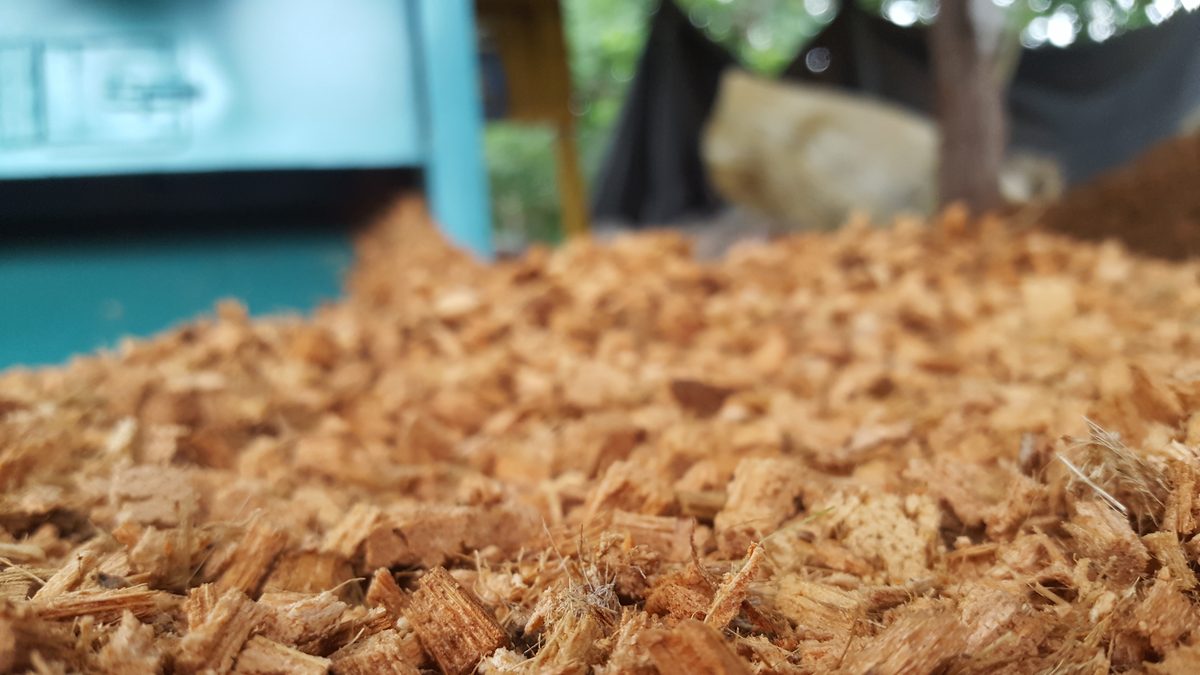
Coconut Husk Chips as Drainage Layer
Husk chips — cut pieces of dry mature coconut husk with controlled dimensions — create the same large-particle air gap that expanded clay (LECA), pumice or gravel provide at the bottom of a pot, moving excess water out of the root zone before it saturates the substrate above [1]. Because chips are organic rather than mineral, an equivalent drainage volume weighs a fraction of expanded clay or gravel, which matters in large decorative planters, rooftop containers and freight-sensitive projects. Carve's chips line is currently in development at the Paraipaba-CE plant; the specifications below are indicative, drawn from the raw dry-husk material and the process design, and will be confirmed with per-lot bench testing once production begins [2].
The agronomic and physical case
A drainage layer's entire job is mechanical: create a zone of large, connected air gaps at the base of a container so gravity pulls excess irrigation water away from the root zone instead of letting it pool and suffocate roots. Expanded clay, pumice and gravel have done this for decades because their particle size and shape resist compaction — the same physical requirement that coarse husk chips satisfy, with an estimated total porosity above 90% and the lowest water-holding figure among coir products (~200 ml/L versus several times that for pith) [1][3].
The difference buyers notice first is weight: a cubic meter of expanded clay or gravel is dense mineral material, while the same volume of dry husk chips is a fraction of that mass — a meaningful line item for large decorative planters, rooftop or balcony installations, and any project where freight or structural load is a constraint. Chips are also organic and will not persist indefinitely the way an inert mineral layer does; mature dry-husk chips are estimated to hold their open structure for roughly 2-3 years before gradual breakdown reduces particle size, which is adequate for most ornamental container cycles but worth planning around in long-term installations.
Technical specification — in development, indicative
Husk chips are in development at Carve's plant. The values below are indicative estimates based on raw material and process design, not yet confirmed by per-lot bench testing. Final specifications will be measured and printed per lot, with a QR code on every bag linking to the full report, once production starts.
| Parameter | Carve Husk Chips — Drainage-layer grade (indicative) |
|---|---|
| Raw material | Dry mature coconut husk (Cocos nucifera L.), Ceará coast, dry-farmed groves, never retted |
| Process | Mechanical cutting to controlled particle dimensions; Natural, Washed and Buffered grades planned |
| Particle size | Controlled-dimension coarse cut pieces; grade sizing to be confirmed for drainage-layer buyers |
| EC (1:5 v/v) | Natural grade estimated 0.8-1.5 mS/cm; do not exceed 1.5 mS/cm; Washed and Buffered grades planned for salt-sensitive plantings above the layer |
| pH | To be measured per lot; raw dry-husk literature range 4.9-6.0 |
| Water retention | Estimated ~200 ml/L — the lowest among coir products, for maximum drainage |
| Total porosity | Estimated >90% |
| Bulk density | To be confirmed; expected substantially lower than expanded clay (LECA) or gravel of equivalent volume |
| Service life (drainage layer) | Estimated 2-3 years before structural breakdown, versus indefinite for inert mineral media |
| Organic matter | Literature reference 91-95% for coir products generally; to be confirmed for chips |
| Packaging | Woven bag, format to be confirmed; lot QR code planned for filmed bench test + origin data |
| Chemistry context | K 1.60%, Cl 1.80%, Na 0.38% dry mass in the raw husk; theoretical EC ceiling of raw material 1.0-1.5 mS/cm before any washing [5] |
In development
Contact us to be notified when husk chips samples and lot testing become available.
Step by step
- Confirm the EC of the lot you receive is at or below 1.5 mS/cm (1:5 extract) before use, especially where the layer sits close to salt-sensitive roots; request Washed or Buffered grade rather than Natural for these installations once available.
- Fill the bottom 15-25% of the pot or planter with chips, sized to the container's depth, exactly as you would size a LECA or gravel layer — deeper containers and heavier substrate loads above generally call for a thicker drainage zone.
- Add a barrier layer (landscape fabric or a coarse mesh) between the chips and the growing substrate above if you want to prevent fine particles from the top layer migrating down and clogging the drainage zone over time.
- Verify the container has an actual drainage outlet — chips manage water movement inside the pot, they do not substitute for a hole or weep system that lets water leave the container entirely.
- Plan a replacement or top-up interval of roughly 2-3 years for the chips layer in continuously irrigated containers, since the organic material gradually breaks down and compacts, unlike an inert mineral layer.
- Take advantage of the weight reduction versus expanded clay or gravel when specifying large rooftop, balcony or decorative planters where structural load or shipping cost is a real constraint.
The data behind this application
- ~200 ml/Lestimated water retention of husk chips — the lowest among coir products, for maximum drainage [1].
- >90%estimated total porosity of husk chips [3].
- 2-3 yearsestimated structural service life of a chips drainage layer before breakdown [1].
- ≤1.5 mS/cmrecommended EC ceiling (1:5 extract) for chips used as a drainage layer [4].
- 0.8-1.5 mS/cmestimated EC (1:5) of Carve's Natural-grade chips, before washing or buffering [5].
- In developmentcurrent status of Carve's chips line at the Paraipaba-CE plant [2].
What this product does not do
Husk chips are in development, so every figure on this page is an indicative estimate rather than a per-lot guarantee; buyers with a near-term order should confirm current status before specifying chips into a program. Unlike expanded clay, pumice or gravel, chips are organic and will decompose over time — an estimated 2-3 years before the layer loses its open structure, meaning this is not a permanent, install-once solution the way an inert mineral drainage layer is, and long-term or high-value installations should budget for eventual replacement. Chips also do not substitute for an actual drainage outlet in the container: without a hole or weep path for water to leave the pot, no internal layer prevents waterlogging. And while Carve's never-retted origin lowers the starting salt baseline relative to typical Asian retted coir, buyers with salt-sensitive plantings directly above the layer should still confirm lot EC before use [4].
Carve's product for this application
Carve's Husk Chips line, currently in development at the Paraipaba-CE plant, is cut from dry mature coconut husk grown in irrigated coconut groves on the Ceará coast — never retted in brackish or tidal water, and irrigated with low-conductivity well water. This stands in direct contrast to the retting process behind much of the coir chips sold internationally, where husks are soaked in ponds, lagoons or tidal water to loosen fiber for extraction, adding sodium and chloride loading beyond the coconut's inherent chemistry and carrying a documented risk of residual pathogens from the retting water. Carve's own composition data (K 1.60%, Na 0.38%, Cl 1.80% dry mass) puts the theoretical EC ceiling of the raw material at just 1.0-1.5 mS/cm even before any washing step — a lower, more predictable starting point for a Washed or Buffered chips grade once production is confirmed [5]. Buyers interested in husk chips for drainage-layer use in large planters, landscaping or greenhouse container programs are encouraged to make contact now to be notified when samples and lot testing become available. For related applications see /en/applications/husk-chips-orchids; for the current product line see /en/products/coir-pith, /en/products/coir-fiber and /en/products/coir-mix; for export questions see /en/import-coir-from-brazil.
References
- [1] Carve internal research, `coir-products-use-cases-grades-2026-09-01.md` — chips water retention (~200 ml/L), aeration profile and estimated structural service life relative to other coir products and mineral drainage media.
- [2] Carve internal status, `state/missions.md` §Product line — husk chips in development, Paraipaba-CE plant.
- [3] Raviv, M. & Lieth, J.H. (eds.), Soilless Culture: Theory and Practice, 2nd ed., Table 8.5, p. 317 — total porosity across coir origins, applied here as an estimate for coarse chip structure.
- [4] Carve internal research, `coir-products-use-cases-grades-2026-09-01.md` §3.1/§3.3 — recommended EC ceiling for direct-contact and near-root coir applications.
- [5] Carve internal composition analysis (EMBRAPA Tabela 1, Tabuleiros Costeiros 2005) — K 1.60%, Na 0.38%, Cl 1.80%; theoretical EC ceiling, `mvp-product-specs.md` §2.
Frequently asked questions
Can coconut husk chips replace LECA or gravel as a drainage layer?
Yes — a bottom layer of coarse husk chips creates the same kind of large-particle air gap that LECA (expanded clay), pumice or gravel provide, moving excess water away from the root zone before it saturates the substrate above. Chips are organic rather than mineral, so they weigh a fraction of an equivalent volume of expanded clay or gravel, which matters most in large decorative planters, rooftop containers and any application where shipping or lifting weight is a cost [1].
How long does a husk chips drainage layer last before it breaks down?
Coarse dry-husk chips are estimated to resist decomposition for roughly 2-3 years in typical container conditions before they compact and lose structure, based on the lignin-rich composition of mature coconut husk. That is long enough for most ornamental container cycles, though it is a finite service life unlike an inert mineral layer such as LECA or gravel, which does not decompose at all [1].
Is Carve's husk chips product available now for drainage use?
Husk chips are in development at Carve's plant in Paraipaba-CE. The specifications on this page are indicative, based on the raw material and process design, and will be confirmed with per-lot bench testing once production starts. Contact us to be notified when samples are available [2].
Does a husk chips drainage layer compact like peat or fine coir pith?
No — the coarse, cut particle structure of chips is specifically what keeps them from compacting the way fine peat or coir pith does under weight and repeated wetting. The large air gaps between chip pieces are the mechanism behind the drainage function itself, and they hold that open structure for the estimated 2-3 year service life before gradual breakdown reduces particle size [1][3].
What EC should husk chips be for use as a drainage layer under ornamental plants?
Since a drainage layer sits in direct contact with irrigation runoff and, over time, root growth from above, the same EC ceiling used for direct-contact coir applications applies: at or below 1.5 mS/cm (1:5 extract). Natural-grade chips from Carve's never-retted dry husk are estimated at 0.8-1.5 mS/cm before any washing step, which is workable for most ornamentals but worth confirming per lot for salt-sensitive species [4][5].
Request a sample
Get in touch to be notified when husk chips samples and complete technical data become available.