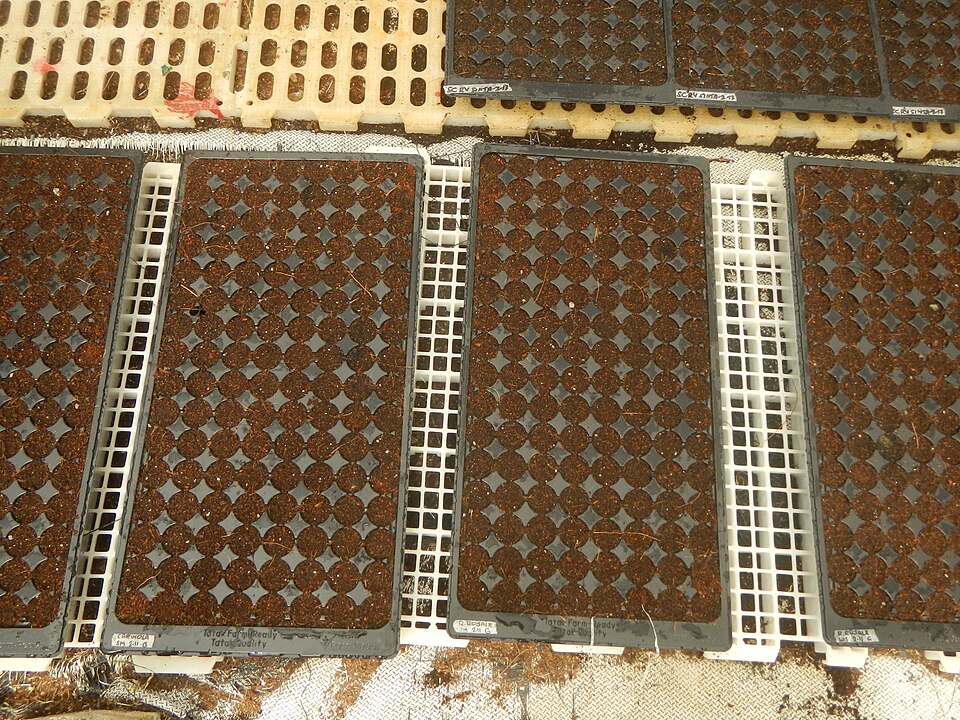
Coir Pith Substrate for Vegetable Seedling Trays
Washed coir pith at EC below roughly 0.7 mS/cm for leafy greens and below 1.0 mS/cm for solanaceous and cucurbit crops is the standard specification for vegetable seedling trays (bandejas), because the 20-35 day cycle is short enough that fine, high-retention pith's moisture consistency matters more than its long-term structural life [1]. Carve's Washed pith is classified at malha 5 fio 20 (~4.13 mm), predominantly under 2 mm, and tested for EC and pH on every lot [2].
The agronomic and physical case
Vegetable tray production is the shortest-cycle application on the coir pith use-case matrix — lettuce, brassicas and similar leafy crops typically move from sowing to transplant in 20 to 35 days [1]. That short window changes the calculus in two ways relative to longer-cycle crops like eucalyptus or coffee. First, germination and early emergence are the most salt-sensitive stages in a plant's life cycle for most vegetable species, and lettuce in particular is documented as osmotically sensitive at emergence — a substrate EC spike at exactly this stage can reduce germination percentage or produce uneven stands even if the same EC would be tolerated later in the crop's life [1][3]. Second, because the cycle is so short, there simply is not enough time for the chemically bound (organically complexed) fraction of potassium and sodium in coir pith to release meaningfully under fertigation — the delayed-release mechanism that motivates buffering in long-cycle crops is not a practical risk here, which is why washing alone (not buffering) is sufficient for bandeja production [1][4].
Physically, the same fine-pith properties that serve eucalyptus and coffee tubetes apply to vegetable trays: a classified particle structure predominantly under 2 mm produces total porosity above 94% and water-holding capacity in the 8-10x dry weight range, which is well matched to small tray cells that would otherwise dry out between the frequent, light irrigation events typical of tray nurseries [5][6]. Some producers in Brazil's Northeast have adopted coir pith specifically because regional pine bark supply is limited or absent, making coir pith the practical structural alternative rather than one option among several equally available choices [1]. The Ceará coast's own coconut coast geography gives regional vegetable nurseries a materially shorter supply chain than importing pine bark or coir from other regions.
Technical specification
Values are guarantees measured and printed per lot; the QR code on every bag links to the full bench-test report.
| Parameter | Carve Washed Coir Pith — Vegetable tray grade |
|---|---|
| Raw material | Mesocarpo of dry mature coconut husk (Cocos nucifera L.), Ceará coast, dry-farmed groves, never retted |
| Process | Mechanical shredding + rotary screen classification (malha 5 fio 20, ~4.13 mm) + 2-3 freshwater soak-drain cycles |
| Particle size | Classified at ~4.13 mm screen; predominantly <2 mm fraction retained |
| EC (1:5 v/v) | Target <0.7 mS/cm for leafy greens, <1.0 mS/cm for solanaceous/cucurbit trays; measured every lot |
| pH | Reported per lot; raw dry-husk literature range 4.9-6.0, rising toward neutral after washing |
| Moisture at dispatch | Guaranteed ≤18% |
| Bulk density (loose, 15-20% moisture) | ~90-95 kg/m3, printed on the bag |
| Water-holding capacity | ≥5x dry weight guaranteed; literature reference 8-10x |
| Total porosity | >94% |
| Organic matter | ≥85% guaranteed (literature 91-95%) |
| Packaging | 100 L woven bag, lot QR code linking to filmed bench test + origin data; smaller-volume packaging available on request |
| Chemistry context | K 1.60%, Cl 1.80%, Na 0.38% dry mass in the raw husk; theoretical EC ceiling of raw material 1.0-1.5 mS/cm before washing [7] |
Control per lot
Every lot is analysed before dispatch. Lots outside the agreed range are held back.
Step by step
- Match the lot's printed EC to the crop group before filling — leafy greens should be routed to lots tested below ~0.7 mS/cm, and solanaceous/cucurbit trays can generally use lots up to ~1.0 mS/cm.
- Pre-wet the pith thoroughly before tray filling; dry coir pith is initially hydrophobic and uneven wetting at fill produces uneven germination.
- Fill tray cells to a light, consistent compaction — overpacking small cells restricts the already-limited air space and slows emergence.
- Sow at the manufacturer-recommended depth for the species; coir pith's fine texture supports good seed-to-media contact for small vegetable seeds.
- Irrigate frequently and lightly during germination, tapering to a normal tray schedule after emergence; coir pith's high water-holding capacity reduces the number of daily irrigation events needed compared to some peat-based mixes, but does not eliminate the need for a germination-stage misting or light-irrigation regime.
- Begin fertigation once true leaves appear, using a program appropriate to a low-EC starting substrate rather than assuming the substrate contributes meaningful background nutrition.
- Monitor for damping-off and related issues as normal nursery practice — coir pith's documented general suppressiveness to some soilborne pathogens in the literature is a secondary benefit, not a substitute for sanitation.
The data behind this application
- 20-35 daystypical cycle length for leafy vegetable tray production (lettuce, brassicas), the shortest among coir pith's main use cases [1].
- <0.7 mS/cmrecommended EC target for leafy greens; <1.0 mS/cm for solanaceous and cucurbit trays [1].
- 1.0-1.5 mS/cmtheoretical maximum EC (1:5) of Carve's raw composition before washing [7].
- ≥94%total porosity of coir pith [5].
- 8-10xwater-holding capacity relative to dry weight, literature reference range [6].
- Part of an estimated 38,000 t/yrtotal Brazilian pó fino demand across blenders, tray production and related segments combined; vegetable trays are a distinct sub-segment within this total, not separately sized in current research [8].
What this product does not do
Coir pith's short-cycle suitability is also its boundary: the same fine, fast-draining-yet-retentive structure that suits a 20-35 day tray cycle degrades within 1.5-2 years under continuous cultivation, so it is not appropriate for multi-cycle reuse without replacement, and growers should not expect it to perform identically in a second or third planting without fresh material. Coir pith alone provides limited macropore drainage compared to a pith-plus-perlite or pith-plus-vermiculite blend; nurseries running dense tray irrigation schedules with limited drainage sometimes still amend pure pith with an inert aggregate to reduce waterlogging risk in wetter climates or seasons. As with all coir pith applications, washing addresses free and loosely bound salts but not the deeper organically bound fraction — irrelevant at this cycle length, but worth understanding if a buyer later expands into longer-cycle crops using the same base material (see /en/products/coir-pith-tomato-substrate for a longer-cycle comparison).
Carve's product for this application
Carve's Washed Coir Pith for vegetable trays is produced from mesocarpo of dry mature coconut husk grown in irrigated coconut groves on the Ceará coast, never retted in brackish or tidal water, and irrigated with low-conductivity well water (64-480 µS/cm). This is the direct opposite of the retting process common in parts of the Asian coir industry, where husks are soaked in ponds, lagoons, or tidal water to loosen fiber for extraction — a process documented in the literature to add sodium and chloride loading beyond the coconut's inherent chemistry, with fresh unwashed Tamil Nadu coir measured at 3.32-4.41 dS/m and raw east-coast material up to 11.25 dS/m [9]. Carve's own composition analysis (K 1.60%, Na 0.38%, Cl 1.80% dry mass) sets a theoretical EC ceiling of just 1.0-1.5 mS/cm even before washing, and the Washed grade brings finished product under 0.7-1.0 mS/cm depending on crop group, tested and printed per lot with a QR code linking to the filmed bench test [7]. Given the Northeast region's limited local pine bark supply, Ceará-based vegetable nurseries also gain a shorter, lower-freight-cost supply chain compared to sourcing coir or bark from further afield [1]. See /en/products/coir-pith for the full pith grade ladder, /en/products/coir-pith-tomato-substrate for a related short-to-medium cycle application, and /en/import-coir-from-brazil for export specification questions.
References
- [1] Carve internal research, `coir-products-use-cases-grades-2026-09-01.md` §3.1 — hortaliça bandeja cycle length, EC targets by crop group, regional pine bark supply gap, Embrapa Ibiapaba demo site.
- [2] Carve internal specification, `mvp-product-specs.md` — malha 5 fio 20 (~4.13 mm) classification and per-lot EC/pH testing protocol.
- [3] General vegetable seed physiology on osmotic sensitivity at germination — standard horticultural science, cross-referenced with Raviv Ch. 8 salinity discussion.
- [4] Carve internal research, `coir-products-use-cases-grades-2026-09-01.md` §2.1 — four-pool salt model and delayed-release mechanism explanation.
- [5] Raviv, M. & Lieth, J.H. (eds.), Soilless Culture: Theory and Practice, 2nd ed., Table 8.5, p. 317 — total porosity across coir origins.
- [6] Raviv Table 8.5, 2nd ed., p. 317 — coir pith water-holding capacity reference range.
- [7] Carve internal composition analysis (EMBRAPA Tabela 1, Tabuleiros Costeiros 2005) — K 1.60%, Na 0.38%, Cl 1.80%; theoretical EC ceiling, `mvp-product-specs.md` §2.
- [8] Carve internal research, `mvp-product-specs.md` §2 — ~38,000 t/yr total addressable pó fino demand across blended segments.
- [9] Raviv Table 8.6, 2nd ed., p. 318, citing Ross et al. 2010/2012 — fresh unwashed and raw Tamil Nadu EC ranges.
Frequently asked questions
What EC is safe for lettuce and leafy green seedling trays?
Target substrate EC below approximately 0.7 mS/cm (1:5 extract) for leafy greens, which are documented as osmotically sensitive during germination and early emergence [1][3].
Can solanaceous vegetable trays (tomato, pepper) use a higher EC than lettuce?
Yes, solanaceous and cucurbit crops generally tolerate substrate EC up to around 1.0 mS/cm in tray production, a somewhat wider band than leafy greens [1].
Do vegetable trays need Buffered coir pith?
No. The 20-35 day cycle is too short for the organically bound potassium/sodium fraction in coir to release meaningfully under fertigation, so Washed grade (which addresses free and loosely bound salts) is the appropriate specification [1][4].
Why is coir pith popular for vegetable trays in Northeast Brazil specifically?
The region has limited local pine bark supply, the traditional substrate base in other parts of Brazil, making coir pith the practical structural alternative. Ceará's own coconut-growing geography also shortens the supply chain relative to importing bark or coir from elsewhere [1].
How does Carve's coir pith compare to retted Asian coir for tray use?
Carve's husk is never retted in brackish or tidal water and is irrigated with low-conductivity well water, giving it a lower theoretical EC ceiling (1.0-1.5 mS/cm) than retted Asian material, which has been measured as high as 11.25 mS/cm raw before washing [7][9].