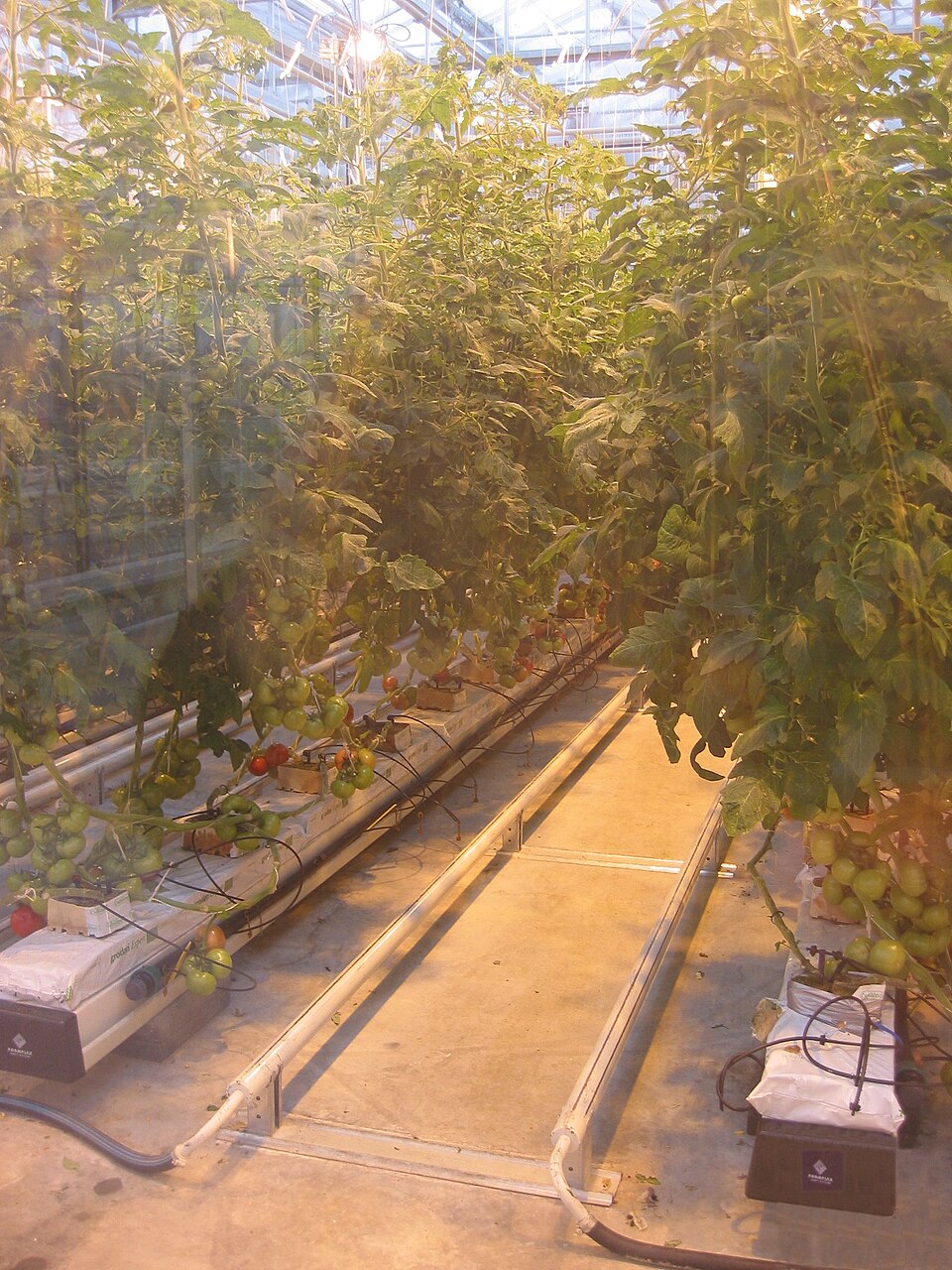
Coir Pith Substrate for Semi-Hydroponic Tomato Production
Washed coir pith is the standard substrate for drain-to-waste semi-hydroponic tomato production over an 8-11 month cycle, and can be used with a K-cut starter-charge protocol to manage the crop's early-season blossom-end-rot risk; recirculating systems should specify Buffered grade instead [1]. Carve's Washed pith, classified at malha 5 fio 20 (~4.13 mm), predominantly under 2 mm, is tested for EC and pH on every lot, with a technical bulletin available describing the starter protocol [2].
The agronomic and physical case
Tomato occupies an unusual position in the coir salt-tolerance landscape: it is one of the most sodium-tolerant fruiting crops in commercial cultivation, documented tolerant to substrate/solution sodium up to roughly 10 mmol/L, well above the level that would concern many other greenhouse crops [1][3]. That tolerance changes the economics of the potassium reservoir that coir naturally carries on its cation exchange sites. In most salt-sensitive crops, coir's organically bound and exchange-site potassium and sodium are a liability that releases gradually under fertigation and needs to be neutralized through buffering. In tomato, the released potassium is largely just... potassium — a macronutrient the plant needs throughout its 8-11 month cycle regardless of source, so washed (not buffered) coir's gradual K release can function as supplemental fertilizer for roughly the first several weeks of the crop, reducing the grower's own potassium input during that window [1].
The complication is specifically at the start of the cycle. The first fruit trusses on a tomato plant are disproportionately vulnerable to blossom-end rot, a physiological disorder driven by localized calcium deficiency at the fruit tip — and calcium uptake is antagonized by high potassium in the root zone (a classic cation-competition effect also documented broadly in Raviv's discussion of salinity-nutrient interactions) [1][4]. If washed coir's K reservoir releases heavily right as the first trusses are setting, the resulting K:Ca imbalance can worsen blossom-end rot incidence precisely when it is most costly to the season's total marketable yield. The practical resolution used by growers running washed coir with tomato is a 'K-cut starter-charge' protocol: reducing supplemental potassium fertigation for the first several weeks specifically because the substrate is already contributing it, while ensuring calcium supply is not simultaneously constrained — converting what would otherwise be a liability into, in effect, free starter fertilizer once it is planned for rather than encountered as a surprise [1].
Recirculating semi-hydroponic systems change this calculus again: because nutrient solution is reused rather than drained to waste, any potassium released by the substrate accumulates in the recirculating loop over time rather than leaching away, which is why recirculating tomato operations are generally advised to specify Buffered grade rather than rely on the K-cut protocol designed for drain-to-waste systems [1].
Technical specification
Values are guarantees measured and printed per lot; the QR code on every bag links to the full bench-test report.
| Parameter | Carve Washed Coir Pith — Tomato semi-hydro grade |
|---|---|
| Raw material | Mesocarpo of dry mature coconut husk (Cocos nucifera L.), Ceará coast, dry-farmed groves, never retted |
| Process | Mechanical shredding + rotary screen classification (malha 5 fio 20, ~4.13 mm) + 2-3 freshwater soak-drain cycles |
| Particle size | Classified at ~4.13 mm screen; predominantly <2 mm fraction retained |
| EC (1:5 v/v) | Target <1.0 mS/cm for drain-to-waste (with K-cut starter protocol); Buffered grade (<0.5 mS/cm, Na/K per RHP-style limits) recommended for recirculating systems |
| pH | Reported per lot; raw dry-husk literature range 4.9-6.0, rising toward neutral after washing |
| Moisture at dispatch | Guaranteed ≤18% |
| Bulk density (loose, 15-20% moisture) | ~90-95 kg/m3, printed on the bag |
| Water-holding capacity | ≥5x dry weight guaranteed; literature reference 8-10x |
| Total porosity | >94% |
| Organic matter | ≥85% guaranteed (literature 91-95%) |
| Packaging | 100 L woven bag, lot QR code linking to filmed bench test + origin data; slab/grow-bag format available on request |
| Chemistry context | K 1.60%, Cl 1.80%, Na 0.38% dry mass in the raw husk; theoretical EC ceiling 1.0-1.5 mS/cm before washing [5] |
Control per lot
Every lot is analysed before dispatch. Lots outside the agreed range are held back.
Step by step
- Decide drain-to-waste versus recirculating before ordering — the two systems require different grades (Washed with K-cut protocol vs Buffered) and this decision should be made up front, not adjusted mid-cycle.
- For drain-to-waste systems, request Carve's K-cut starter-charge technical bulletin and reduce supplemental potassium fertigation for the first 3-4 weeks while maintaining full calcium supply, to pre-empt early blossom-end rot risk.
- Pre-wet slabs or bags to full saturation before transplant, and allow proper drainage before planting to establish the correct air-to-water ratio in the root zone.
- Transplant at standard density; monitor first-truss fruit closely for blossom-end rot symptoms in the first weeks as a check that the K-cut protocol is calibrated correctly for your specific water and fertigation program.
- Track drain (leachate) EC and pH regularly through the 8-11 month cycle — this is standard practice in semi-hydroponic tomato regardless of substrate choice and is the primary tool for catching a developing imbalance early.
- From roughly week 5 onward, return to a standard potassium fertigation program as the substrate's initial K contribution tapers off.
- For recirculating systems, use Buffered-grade coir and follow standard RHP-style monitoring (Na, K, Ca, Mg in the recirculating solution) since accumulation dynamics differ from drain-to-waste.
The data behind this application
- 4,500 t/yrestimated Brazilian addressable demand for coir pith in semi-hydroponic tomato production [6].
- 8-11 monthstypical tomato semi-hydroponic cycle length [1].
- Up to ~10 mmol/Ldocumented sodium tolerance threshold for tomato, among the highest of common fruiting greenhouse crops [1][3].
- 1.0-1.5 mS/cmtheoretical maximum EC (1:5) of Carve's raw composition before washing [5].
- ≥94%total porosity of coir pith [7].
- 8-10xwater-holding capacity relative to dry weight, literature reference range [7].
What this product does not do
The K-cut starter protocol is a management practice, not a substitute for grower-side monitoring — it reduces but does not eliminate blossom-end rot risk, and calcium supply, irrigation frequency, humidity and cultivar all remain contributing factors that must be managed independently. Washed grade's K reservoir is a genuine agronomic asset for tomato specifically because of the crop's high sodium tolerance and K nutrient demand; this same reasoning does not transfer to other fruiting crops with lower sodium tolerance (blueberry is the clearest counter-example — see the buffering discussion referenced from /en/products/coir-pith) and should not be assumed to generalize. Recirculating systems that use Washed rather than Buffered grade risk gradual potassium and sodium accumulation in the nutrient loop over a multi-month cycle, which is why Buffered is the recommended specification for that system type regardless of the drain-to-waste K-cut logic. As with all Carve pith products, real-world EC and starter-protocol timing should be validated against your specific water source and fertigation program before scaling to a full commercial planting.
Carve's product for this application
Carve's Washed Coir Pith for tomato semi-hydroponics is produced from mesocarpo of dry mature coconut husk grown in irrigated coconut groves on the Ceará coast, never retted in brackish or tidal water, and irrigated with low-conductivity well water (64-480 µS/cm). This is a structural departure from the retting process common in Asian coir production, where husks are soaked in ponds, lagoons or tidal water to loosen fiber for extraction — documented in the literature to add sodium and chloride loading beyond the coconut's own chemistry, with raw material reaching up to 11.25 dS/m on the Tamil Nadu east coast [8]. Carve's own composition analysis (K 1.60%, Na 0.38%, Cl 1.80% dry mass) sets a theoretical EC ceiling of 1.0-1.5 mS/cm before washing — a lower, more controllable starting point that supports the K-cut starter protocol precisely because the total potassium reservoir is smaller and more predictable than in higher-EC retted material [5]. For recirculating operations or export-grade RHP specifications, Carve also produces a Buffered grade using a Ca(NO3)2 soak step; ask your Carve contact about current Buffered-grade availability. Every lot carries a QR code opening the filmed bench test, origin data and processing date. See /en/products/coir-pith for the full grade ladder, /en/products/coir-pith-substrate-blending for formulator-scale supply, and /en/import-coir-from-brazil for export specification and RHP-style questions.
References
- [1] Carve internal research, `coir-products-use-cases-grades-2026-09-01.md` §2-3 — tomato cycle length, sodium tolerance, K-cut starter-charge protocol, recirculating vs drain-to-waste grade recommendation.
- [2] Carve internal specification, `mvp-product-specs.md` — malha 5 fio 20 (~4.13 mm) classification, per-lot EC/pH testing.
- [3] General horticultural literature on tomato sodium tolerance thresholds, cross-referenced with Carve internal segment research.
- [4] Raviv, M. & Lieth, J.H. (eds.), Soilless Culture: Theory and Practice, 2nd ed., Ch. 6, pp. 228-231 — cation competition (Na+/K+ vs Ca2+ uptake).
- [5] Carve internal composition analysis (EMBRAPA Tabela 1, Tabuleiros Costeiros 2005) — K 1.60%, Na 0.38%, Cl 1.80%; theoretical EC ceiling, `mvp-product-specs.md` §2.
- [6] Carve internal research, `coir-products-use-cases-grades-2026-09-01.md` §3.1 — ~4,500 t/yr addressable volume, tomate semi-hidro segment.
- [7] Raviv Table 8.5, 2nd ed., p. 317 — total porosity and water-holding capacity of coir pith.
- [8] Raviv Table 8.6, 2nd ed., p. 318, citing Ross et al. 2010/2012 — raw Tamil Nadu east-coast EC up to 11.25 dS/m.
Frequently asked questions
Can Washed coir pith be used for tomato without buffering?
Yes, for drain-to-waste semi-hydroponic systems, using a K-cut starter-charge protocol for the first several weeks to manage blossom-end rot risk on early fruit trusses. Recirculating systems should use Buffered grade instead, since released potassium accumulates in a closed loop rather than draining away [1].
Why is tomato different from other crops regarding coir's potassium content?
Tomato is unusually sodium-tolerant (up to roughly 10 mmol/L) and has a genuine potassium demand throughout its 8-11 month cycle, so the gradual K release from washed coir can function as partial starter fertilizer rather than a pure liability, unlike in more salt-sensitive crops [1][3].
What is the K-cut starter-charge protocol?
It is a fertigation adjustment for the first 3-4 weeks of a tomato crop, reducing supplemental potassium (since the substrate is already releasing some) while maintaining full calcium supply, to reduce blossom-end rot risk on the earliest fruit trusses [1].
Does Carve sell Buffered coir pith for recirculating tomato systems?
Buffered grade (wash plus a Ca(NO3)2 soak step) is part of Carve's grade ladder for salt-sensitive and recirculating applications; availability should be confirmed directly with Carve as production scales [1].
How does Carve's dry-husk origin affect tomato substrate performance?
Because Carve's husk is never retted in brackish water and is irrigated with low-conductivity well water, its raw composition has a lower theoretical EC ceiling (1.0-1.5 mS/cm) than much Asian retted coir, giving growers a smaller, more predictable potassium reservoir to manage with the K-cut protocol [5][8].