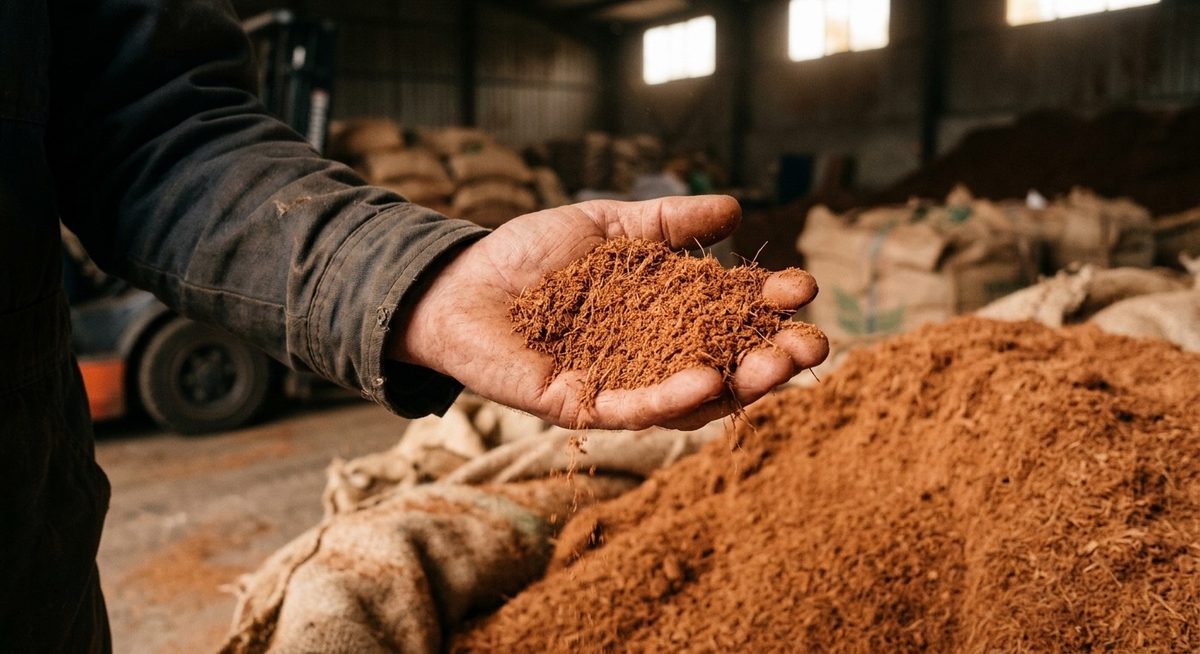
Coir Pith for Substrate Formulators and Blenders
Natural-grade (unwashed) coir pith is the standard, most cost-effective input for substrate formulators and blenders who dilute pith to 30% or less of a final mix and manage EC at the blend level rather than the raw-material level [1]. Carve's Natural pith, classified at malha 5 fio 20 (~4.13 mm), predominantly under 2 mm, is delivered dry-matter-guaranteed at ≤18% moisture with EC tested and printed per lot, letting formulators dilute against a known number rather than an estimate [2].
The agronomic and physical case
Substrate formulators — companies that manufacture their own blended growing media for resale, rather than end-use nurseries buying a finished substrate — occupy a different position in the coir economics than any single crop segment, because they do not use coir pith raw; they dilute it into a multi-component mix (typically alongside bark, perlite, vermiculite or other coir grades) at a controlled inclusion rate, commonly 30% or less of total blend volume [1]. That dilution changes the arithmetic on salinity dramatically: a pith lot at 1.5 mS/cm EC, blended at 30% into an otherwise near-zero-EC mix, reads roughly 0.45 mS/cm in the finished product — comfortably inside tolerance for the great majority of end applications the formulator will sell into [1]. This means formulators do not generally need Washed or Buffered grade pith; they can use Natural grade, avoid paying for a washing step they do not need, and manage the final EC target through their own blend formulation and, if needed, the addition of gypsum, dolomite or other corrective amendments during manufacture.
This is the largest single addressable use case for coir pith in Brazil by volume, because formulators buy at scale for resale rather than at nursery-scale for direct consumption, and because they are indifferent to some of the finer quality distinctions (EC, pH nuance) that matter enormously to end-use crops with sensitive salt tolerances [1][3]. What formulators do care about, and what differentiates suppliers to them, is consistency lot to lot (a formulator recalibrating their recipe every batch is expensive), guaranteed low moisture (paying for water weight in a bulk freight purchase is a direct cost), and traceable documentation they can pass along or reference if their own finished-product buyer asks questions about input quality. Coir pith's physical properties (fine particle structure, high total porosity, strong water-holding capacity) remain the value driver in the finished blend regardless of whether the pith itself was washed — the formulator's other blend components and final EC management do the salt-control work [4].
Technical specification
Values are guarantees measured and printed per lot; the QR code on every bag links to the full bench-test report.
| Parameter | Carve Natural Coir Pith — Formulator/blender grade |
|---|---|
| Raw material | Mesocarpo of dry mature coconut husk (Cocos nucifera L.), Ceará coast, dry-farmed groves, never retted |
| Process | Mechanical shredding + rotary screen classification (malha 5 fio 20, ~4.13 mm) — no washing, no additives, no chemicals |
| Particle size | Classified at ~4.13 mm screen; predominantly <2 mm fraction retained |
| EC (1:5 v/v) | Measured every lot, printed with the bag; contract acceptance ceiling set per buyer; Carve's own dry-husk composition implies a theoretical raw ceiling of 1.0-1.5 mS/cm |
| pH | Reported per lot; raw dry-husk literature range 4.9-6.0 |
| Moisture at dispatch | Guaranteed ≤18% — protects dry-matter content per freight kilogram, a direct cost factor for bulk buyers |
| Bulk density (loose, 15-20% moisture) | ~90-95 kg/m3, printed per lot; working range 85-110 kg/m3 |
| Water-holding capacity | ≥5x dry weight guaranteed; literature reference 8-10x |
| Total porosity | >94% |
| Organic matter | ≥85% guaranteed (literature 91-95%) |
| Packaging | 100 L woven bag, bulk options available on request; lot QR code linking to filmed bench test + origin data |
| Washed grade | Also available on request for formulators building a lower-EC finished line; consult current pricing |
Control per lot
Every lot is analysed before dispatch. Lots outside the agreed range are held back.
Step by step
- Confirm the lot's printed EC, then calculate the target inclusion rate against your finished-blend EC ceiling using simple dilution math (blend EC ≈ pith EC × inclusion fraction, as a first-order estimate before accounting for other blend components' own contribution).
- Request Natural grade for standard blends where 30% or lower inclusion keeps finished EC well inside tolerance; request Washed grade if your finished-blend target requires it, or if your inclusion rate runs above 30%.
- Verify moisture on receipt against the ≤18% guarantee — since formulators typically buy and price by weight or volume at scale, moisture directly affects landed cost per unit of usable dry matter.
- Incorporate into your blend formulation per your standard manufacturing process; coir pith's fine particle structure integrates well with bark, perlite and other common blend components without special handling.
- Verify finished-blend EC and pH against your own quality control before packaging or shipping to end customers, treating the raw pith EC as an input to your recipe rather than a finished specification.
- Maintain lot traceability by retaining Carve's QR-linked bench test data alongside your own blend batch records, useful if an end customer requests input documentation.
- Reassess inclusion rate periodically if lot-to-lot EC varies meaningfully; Carve's per-lot testing is designed to flag this variation before it reaches your production line, but blend recipes should still be checked against real incoming data rather than a fixed historical assumption.
The data behind this application
- Part of an estimated 38,000 t/yr total addressable coir pith demand in Brazilthe formulator/blender channel is the single largest sub-segment within this figure, alongside paisagismo (landscaping) and compost bedding as other non-crop-sensitive outlets [5].
- ~45% of current addressable pipelineestimated share of Brazilian coir pith demand from EC-tolerant segments (blenders, landscaping, fiber industrial buyers) reachable without any washing infrastructure [6].
- 30% or lesstypical formulator inclusion rate for coir pith in a finished multi-component blend [1].
- 1.5 mS/cm pith at 30% inclusion ≈ 0.45 mS/cm finished blendillustrative dilution math showing why Natural-grade pith is adequate for most formulator applications [1].
- ≤18%Carve's guaranteed dispatch moisture, versus 52% shipping moisture documented for at least one major Brazilian competitor, a direct cost difference for buyers paying by weight [7].
What this product does not do
Natural-grade pith is not appropriate for a formulator building a finished product marketed as low-salt, washed, or suitable for salt-sensitive end crops without further processing on the formulator's own line, or by ordering Washed grade directly from Carve. Dilution math is a useful first-order estimate but is not a substitute for testing the actual finished blend — other blend components can contribute their own EC, and blending is not always perfectly linear in practice depending on mixing method and material interaction. Coir pith bought Natural for blending purposes carries the full raw-material EC variability documented in the literature (dry husk spans a wide range depending on age and exposure), so formulators running tight finished-product specifications should request Carve's per-lot EC data before each batch rather than assume a fixed average. As with all coir pith grades, Natural is a physical structural input, not a fertilizer program component — formulators still need to design the nutrient-charge (starter fertilizer) component of their finished blend independently.
Carve's product for this application
Carve's Natural Coir Pith for formulators is produced from mesocarpo of dry mature coconut husk grown in irrigated coconut groves on the Ceará coast, never retted in brackish or tidal water, and irrigated with low-conductivity well water (64-480 µS/cm). This origin path sets a materially different starting composition from much of the Asian raw-coir supply referenced in the literature, where retting in ponds, lagoons or tidal water is documented to add sodium and chloride loading well beyond the coconut's own chemistry — raw material has been measured as high as 11.25 dS/m on Tamil Nadu's east coast before any washing [8]. Carve's own dry-husk composition (K 1.60%, Na 0.38%, Cl 1.80%) implies a theoretical EC ceiling of just 1.0-1.5 mS/cm even unwashed, giving formulators a lower, more dilutable starting point when calculating finished-blend EC [9]. Every lot is tested for EC, pH, moisture, bulk density and particle-size conformance before dispatch, with results accessible via a QR code printed on every bag — documentation formulators can carry through to their own end customers if input traceability is requested. Carve also produces Washed pith for formulators building lower-EC finished lines, and Fiber for aeration-focused blends (see /en/products/coir-fiber). For the full pith grade ladder and additional crop-specific applications, see /en/products/coir-pith; for export volumes and international buyers, see /en/import-coir-from-brazil.
References
- [1] Carve internal research, `coir-products-use-cases-grades-2026-09-01.md` §3.1 — formulator/blender segment, 30% inclusion rate, dilution economics, Substrato Raiz/Carolina Soil/Tropstrato/Agrofior buyer references.
- [2] Carve internal specification, `mvp-product-specs.md` — malha 5 fio 20 (~4.13 mm) classification, per-lot testing protocol, ≤18% moisture gate.
- [3] Carve internal research, `coir-products-use-cases-grades-2026-09-01.md` §7 — G-NAT addressable volume and readiness assessment.
- [4] Raviv, M. & Lieth, J.H. (eds.), Soilless Culture: Theory and Practice, 2nd ed., Ch. 8 — coir pith physical properties as a blend component.
- [5] Carve internal specification, `mvp-product-specs.md` §2 — ~38,000 t/yr total addressable pó fino demand.
- [6] Carve internal research, `coir-products-use-cases-grades-2026-09-01.md` §7.1/7.4 — ~45% of pipeline reachable via Natural grade without washing investment.
- [7] Carve internal competitive intelligence, `mvp-product-specs.md` §8 — competitor 52% shipping moisture vs Carve ≤18% dispatch gate.
- [8] Raviv Table 8.6, 2nd ed., p. 318, citing Ross et al. 2010/2012 — raw Tamil Nadu east-coast EC up to 11.25 dS/m.
- [9] Carve internal composition analysis (EMBRAPA Tabela 1, Tabuleiros Costeiros 2005) — K 1.60%, Na 0.38%, Cl 1.80%; theoretical EC ceiling, `mvp-product-specs.md` §2.
Frequently asked questions
Do substrate formulators need Washed coir pith, or is Natural grade sufficient?
For most formulators, Natural grade is sufficient because pith is typically diluted to 30% or less of the finished blend, which brings even a moderately saline raw material down to a low finished EC. Formulators building specifically low-EC lines, or blending above 30% inclusion, should order Washed grade instead [1].
How much does coir pith EC drop when diluted into a blend?
As a first-order estimate, blend EC scales roughly with inclusion fraction — for example, 1.5 mS/cm pith at 30% inclusion reads approximately 0.45 mS/cm in the finished mix. This is an estimate, not a guarantee; formulators should test their actual finished blend [1].
Why does dispatch moisture matter for bulk formulator buyers?
Formulators typically buy and price by weight or bulk volume, so a lower dispatch moisture (Carve guarantees ≤18%) means more usable dry matter per unit purchased and per freight kilogram, compared to product shipped wetter [7].
Can Carve supply coir pith in bulk formats for formulators rather than 100L bags?
Bulk options are available on request; formulators should discuss volume and logistics requirements directly with Carve for the appropriate packaging and delivery format.
What documentation does Carve provide for formulators who need input traceability?
Every lot is tested for EC, pH, moisture, bulk density and particle-size conformance, with results accessible via a QR code printed on the bag linking to a filmed bench test, origin data and processing date — documentation formulators can reference for their own customers if asked.