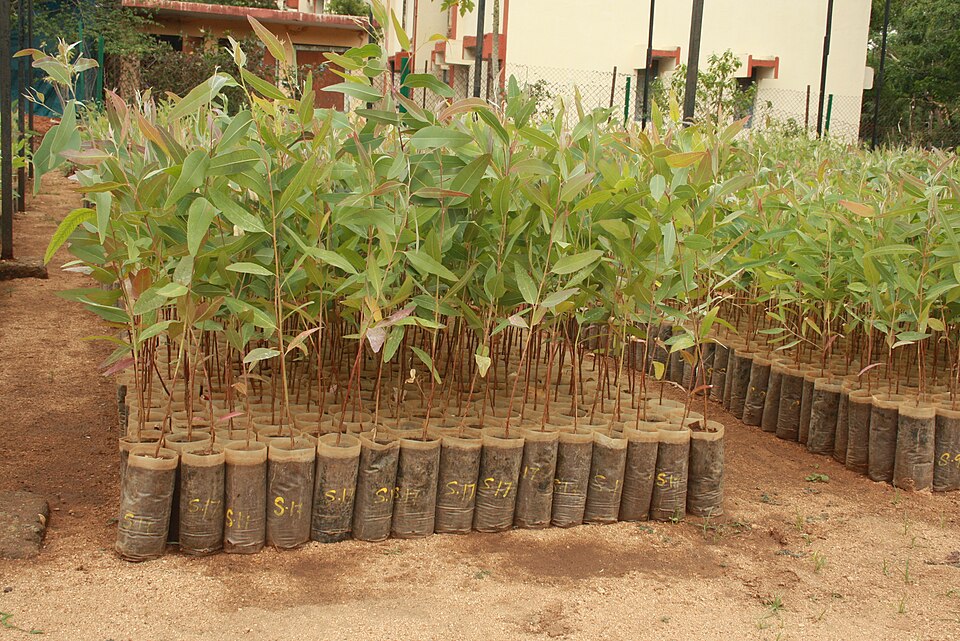
Coir Pith Substrate for Eucalyptus Seedlings
Washed coir pith with electrical conductivity (EC) below 1.0 mS/cm (1:5 extract) is the standard substrate for clonal eucalyptus mini-cuttings and germinant tubete production, because it holds enough water for a 90-120 day rooting cycle while keeping osmotic stress low enough for fragile root initials [1][2]. Carve's fine pith (malha 5 fio 20, ~4.13 mm classification, predominantly under 2 mm) delivers this water-holding capacity from dry mature husk sourced on the Ceará coast [3]. For clonal nurseries specifically, request the Washed grade; seed-propagated lines with more root vigor can often use Natural at a lower delivered cost, subject to a per-lot EC ceiling set in contract.
The agronomic and physical case
Clonal eucalyptus propagation is a two-stage process: a mini-cutting is stuck into a plug of substrate with almost no root system, and it must root and establish before it can regulate its own water and ion uptake. During that window the cutting is more sensitive to substrate salinity than an established plant, because there is no canopy-driven transpiration pull to dilute the salt concentration at the root surface, and because tissue that has not yet formed a functional root cortex has weaker exclusion mechanisms against Na+ and Cl- [1][4]. Fine coir pith is well suited to this stage on physical grounds independent of salinity: its particle structure (predominantly under 2 mm after classification) creates a dense network of micro- and meso-pores that gives it the highest water-holding capacity of the coir product line, commonly cited at 8-10x dry weight in the literature, while total porosity stays above 94% [3][5]. That combination means the plug stays moist between irrigation cycles in a small tubete cell without waterlogging the root zone — the same reason coir pith outperforms straight pine bark or soil-based mixes in tubete nurseries across Brazil [6].
The salinity side of the story is chemical. Raw dry coconut husk carries potassium, sodium and chloride salts from the coconut's own biology, concentrated on cation exchange sites and in pore water. The scientific literature on Asian coir documents wide variation depending on origin, particle size and whether the husk was retted (soaked in ponds or lagoons, sometimes tidal or brackish water, to loosen the fiber before mechanical extraction): fresh unwashed Tamil Nadu coir measured 3.32-4.41 dS/m (equivalent to mS/cm) by particle size, and raw material from the Tamil Nadu east coast reached as high as 11.25 dS/m before washing [7]. Retting in brackish or tidal water is a well-documented mechanism for loading extra sodium into the fiber and pith beyond what the coconut itself contributes [7][8]. Two to three freshwater soak-drain cycles bring EC down substantially — the literature reports a drop from 6.5 to 0.14 dS/m after five successive washes, with a corresponding pH rise from 5.9 to 7.8 as exchangeable acidity is diluted [7]. That washing response is why 'Washed' is a distinct, orderable grade rather than a marketing label: it is a real reduction in the pool of salts sitting in the pore water and on the most accessible exchange sites, achieved mechanically with fresh water, no chemicals.
Technical specification
Values are guarantees measured and printed per lot; the QR code on every bag links to the full bench-test report.
| Parameter | Carve Washed Coir Pith — Eucalyptus grade |
|---|---|
| Raw material | Mesocarpo of dry mature coconut husk (Cocos nucifera L.), Ceará coast, dry-farmed groves, never retted |
| Process | Mechanical shredding + rotary screen classification (malha 5 fio 20, ~4.13 mm) + 2-3 freshwater soak-drain cycles |
| Particle size | Classified at ~4.13 mm screen; predominantly <2 mm fraction retained |
| EC (1:5 v/v) | Target <1.0 mS/cm, measured every lot, contract acceptance limit set with buyer |
| pH | Reported per lot; raw dry-husk literature range 4.9-6.0, rising toward neutral after washing |
| Moisture at dispatch | Guaranteed ≤18% |
| Bulk density (loose, 15-20% moisture) | ~90-95 kg/m3, printed on the bag; working range 85-110 kg/m3 |
| Water-holding capacity | ≥5x dry weight guaranteed; literature reference 8-10x |
| Total porosity | >94% |
| Organic matter | ≥85% guaranteed (literature 91-95%) |
| Packaging | 100 L woven bag, lot QR code linking to filmed bench test + origin data |
| Chemistry context | K 1.60%, Cl 1.80%, Na 0.38% dry mass in the raw husk — the low sodium fraction is the structural reason our theoretical EC ceiling sits at 1.0-1.5 mS/cm before any washing [9] |
Control per lot
Every lot is analysed before dispatch. Lots outside the agreed range are held back.
Step by step
- Confirm the lot EC on the QR-linked bench test before filling trays; if the nursery's protocol requires a tighter band than the standing contract limit, request a matching lot or blend with a lower-EC lot on hand.
- Rehydrate the pith to field capacity before filling tubetes — coir pith is hydrophobic when very dry and needs a pre-wet step (submerge or top-water slowly) to avoid channeling and uneven moisture in the cell.
- Fill tubetes loosely and avoid over-compaction; the fine particle structure that gives high water-holding capacity also means overpacking reduces air-filled porosity and can suffocate the developing root plug.
- Stick mini-cuttings or sow germinants per the nursery's standard protocol; coir pith's near-neutral to mildly acidic pH (post-wash) sits inside the tolerance band for eucalyptus rooting hormone activity.
- Irrigate on a schedule tuned to the substrate's water-holding curve — coir pith releases a higher fraction of its held water as easily available water than peat in some studies, which typically means slightly longer intervals between irrigation events are possible without stress, but nursery-specific calibration is still required.
- Track EC in the leachate periodically during the first 30-45 days; fertigation adds salts on top of the substrate's own baseline, and the two should be managed as one budget, not independently.
- At transplant (typically 90-120 days), inspect root plug integrity — coir pith's pore structure should still be largely intact at this stage; if you see excessive compaction or waterlogging, revisit fill density and irrigation volume for the next cycle.
The data behind this application
- 12,000 t/yrestimated Brazilian addressable demand for coir pith in eucalyptus/pinus tubete production, the largest single application segment for pith nationally [10].
- 3.32-4.41 dS/mfresh unwashed Tamil Nadu coir EC by particle size (Ross et al. 2012, cited in Raviv Table 8.6) [7].
- Up to 11.25 dS/mraw coir from Tamil Nadu's east coast before washing (Ross et al. 2010) [7].
- 6.5 → 0.14 dS/mEC reduction after five successive freshwater washes, with pH rising from 5.9 to 7.8 (Raviv, citing washing/buffering literature) [7].
- 1.0-1.5 mS/cmtheoretical maximum EC (1:5) of Carve's raw composition based on measured dry-husk chemistry (K 1.60%, Na 0.38%, Cl 1.80%), the ceiling before any washing is applied [9].
- ≥94%total porosity of coir pith, comparable across Philippine, Indian, Sri Lankan and Mexican sources despite wide bulk-density variation (40-80 kg/m3 across origins) [11].
- ≤18%Carve's guaranteed moisture at dispatch, versus a documented 52% shipping moisture for at least one major Brazilian competitor, meaning more dry matter delivered per freight kilogram [12].
What this product does not do
Coir pith is a rooting-stage substrate, not a long-term growing medium. Its fine particle structure that maximizes water retention also means it degrades faster than coarser coir grades — literature durability estimates for fine-grade coir sit around 1.5-2 years in continuous use, which is irrelevant for a 90-120 day tubete cycle but disqualifies pure pith for anything multi-year [13]. Washing removes salts from free pore water and a portion of the more loosely held exchange-site cations, but it does not reach potassium and sodium that are chemically bound inside the organic structure of the pith; that fraction requires a divalent-cation buffering step (Ca(NO3)2 soak), which Carve's Washed grade does not include. For eucalyptus tubete cycles under about 120 days this is not a practical problem — there is not enough time under fertigation for that bound fraction to release meaningfully — but Washed pith is not a substitute for Buffered grade in crops with longer cycles or stricter salt tolerances (see /en/products/coir-pith and the buffering discussion on /en/import-coir-from-brazil). Coir pith alone also provides no macropore drainage architecture; nurseries running very wet irrigation regimes on heavy or poorly-drained bench systems sometimes blend in coarser fiber for extra aeration (see /en/products/coir-fiber).
Carve's product for this application
Carve's Washed Coir Pith is produced from mesocarpo of dry mature coconut husk sourced from irrigated coconut groves on the Ceará coast. The husk is never retted in brackish or tidal water — the traditional Asian process that loosens fiber for extraction but also loads extra sodium and chloride into the material. Instead, the coconuts are dry-farmed and irrigated with low-conductivity well water measured at 64-480 µS/cm, and the husk is left to dry naturally before mechanical processing. This origin path is the mechanism behind a meaningfully lower starting point than the Asian raw-coir range documented in the literature: fresh unwashed Tamil Nadu coir at 3.32-4.41 dS/m, and east-coast raw material up to 11.25 dS/m, both a product of retting-associated salt loading on top of the coconut's own chemistry [7]. Carve's own dry-husk composition analysis (K 1.60%, Na 0.38%, Cl 1.80%) sets a theoretical maximum EC of only 1.0-1.5 mS/cm at 1:5 dilution even before washing — a materially lower ceiling than Asian retted material starts from [9]. Washing then brings that already-lower baseline under 1.0 mS/cm, tested on every lot and printed with a QR code that opens the filmed bench test, husk origin and processing date. Every bag carries a per-lot moisture guarantee of ≤18%, keeping dry-matter content high relative to wet-shipped competitor product. For nurseries wanting to see the full product line — pith, fiber, blended mix, and chips under development — see /en/products/coir-pith, /en/products/coir-fiber and /en/products/coir-mix. For export logistics and country-level sourcing questions, see /en/import-coir-from-brazil; for facility and quality-control detail, see /en/company/facts.
References
- [1] Raviv, M. & Lieth, J.H. (eds.), Soilless Culture: Theory and Practice, 2nd ed., Chapter 8 (Carlile), pp. 312-320 — coir pith CEC, salinity thresholds, washing/buffering process.
- [2] EMBRAPA COT-226-19 (Tabuleiros Costeiros, Aracaju) — dry-husk EC, pH, porosity, retention panel.
- [3] Carve internal specification, `mvp-product-specs.md` — malha 5 fio 20 (~4.13 mm) classification (Fábio Silveira/UsiCoco, 20 yrs fabrication experience) confirmed against EMBRAPA CT-054/COT-226-19 and SciELO green-coir sieve literature.
- [4] General plant-propagation physiology on osmotic stress in unrooted cuttings — standard nursery science, cross-referenced with Raviv Ch. 8 salinity-nutrient interaction discussion.
- [5] Raviv Table 8.5, 2nd ed., p. 317 — coir pith bulk density (Philippines 40-80, Sri Lanka 72-89, India 56, Mexico 61-72, Ivory Coast 71 kg/m3) and total porosity (85.8-96.3%).
- [6] Carve internal research, `coir-products-use-cases-grades-2026-09-01.md` §3.1 — eucalipto/pinus tubete segment sizing and power-user identification (Francisco/Eucapinus, Bracell, Veracel, Suzano, ArborGen).
- [7] Raviv Table 8.6, 2nd ed., p. 318, citing Ross et al. 2010 and 2012 — fresh unwashed Tamil Nadu EC by particle size, raw east/west coast EC ranges, and sequential-wash EC/pH response.
- [8] Ross et al. (as cited in Raviv Ch. 8) — retting method and origin as drivers of raw coir salt loading.
- [9] Carve internal composition analysis (EMBRAPA Tabela 1, Tabuleiros Costeiros 2005) — K 1.60%, Na 0.38%, Cl 1.80% dry mass; theoretical EC ceiling calculation, `mvp-product-specs.md` §2.
- [10] Carve internal research, `coir-products-use-cases-grades-2026-09-01.md` §3.1 — ~12,000 t/yr addressable volume for washed pith in eucalipto/pinus tubetes.
- [11] Raviv Table 8.5, 2nd ed., p. 317 — total porosity comparison across coir origins.
- [12] Carve internal competitive intelligence, `mvp-product-specs.md` §8 — competitor shipping moisture (52%, CEO statement on national broadcast) vs Carve's ≤18% dispatch gate.
- [13] Romero, A., webinar (Science Fetti/El Semillero, Colombia, 2025), cited in Carve internal research — fine-grade coir durability 1.5-2 years in-substrate.
Frequently asked questions
What EC should coir pith be for eucalyptus clonal seedlings?
Commercial clonal nurseries generally target substrate EC below 1.0 mS/cm at a 1:5 water dilution for the rooting and early-growth stage, because unrooted cuttings are more sensitive to substrate salinity than established plants [1][2]. Carve's Washed grade is produced to meet this target, tested and printed per lot.
Can Natural (unwashed) coir pith be used for eucalyptus seedlings?
It depends on the propagation method. Seed-raised seedlings with a more developed root system at transplant can sometimes tolerate Natural-grade pith within a contract EC ceiling, but the great majority of industrial eucalyptus nurseries in Brazil run clonal mini-cutting systems, which are more salt-sensitive during rooting and typically specify Washed grade [1].
Why does washing lower coir pith's EC?
Fresh water dissolves and carries away salts sitting in pore water and on the most loosely held cation exchange sites. The literature documents EC dropping from 6.5 to 0.14 dS/m after five successive washes. Washing does not remove salts chemically bound deeper in the organic structure, which is why longer-cycle, more salt-sensitive crops sometimes require an additional buffering step [7].
How is Carve's coir pith different from Asian coir for this use case?
Asian raw coir is frequently produced by retting husks in ponds, lagoons or tidal water to loosen the fiber, a process documented to load extra sodium and chloride beyond the coconut's own chemistry — raw material has been measured up to 11.25 dS/m before washing. Carve's husk is dry-farmed on the Ceará coast, irrigated with low-conductivity well water (64-480 µS/cm), and never retted, giving a lower starting salinity before any washing is applied [7][9].
What water-holding capacity does coir pith offer versus pine bark for tubetes?
Coir pith's fine particle structure produces total porosity above 94% and water-holding capacity commonly cited at 8-10x dry weight, higher than typical pine-bark substrates, which is a core reason Brazilian tubete nurseries — especially in regions without local pine bark supply — have adopted coir pith at scale [3][5][6].