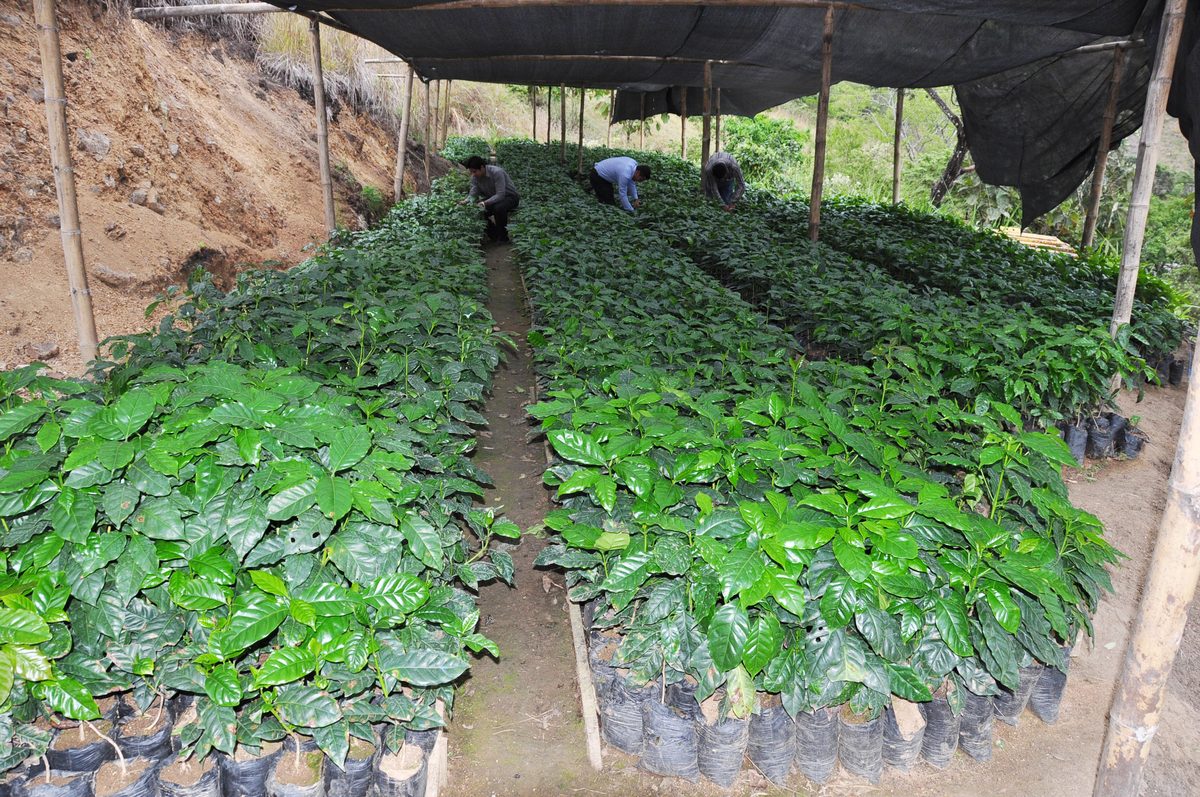
Coir Pith Substrate for Coffee Seedlings
Washed coir pith below 1.0 mS/cm EC (1:5 extract) is the standard substrate for tubete-grown coffee seedlings, matching the crop's 4-7 month nursery cycle with consistent moisture and a low, controlled salt background [1][2]. Carve's fine pith is classified at malha 5 fio 20 (~4.13 mm), predominantly under 2 mm, giving it the highest water-holding capacity of the coir product line — a property especially valuable in coffee's slower-release feeding regime, where the substrate itself needs to be a stable, low-noise background rather than an unpredictable source of potassium or sodium [3].
The agronomic and physical case
Coffee tubete production runs a longer nursery cycle than most horticultural crops — typically 4 to 7 months from sowing or cutting to field-ready seedling — and Brazilian specialty and commercial nurseries have converged on slow-release fertilization as the standard feeding approach for that window [1]. That combination matters for substrate choice in a specific way: because correction of a fertility problem happens slowly (there is less room to flush and re-dose compared to a liquid-fed, short-cycle crop), the substrate needs to start from a predictable, low salt baseline rather than dump an unplanned pulse of potassium or sodium partway through the cycle [1][4]. Coir pith's cation exchange capacity holds a meaningful fraction of potassium and sodium on its particle surfaces; how much of that is still present at the point of sale depends entirely on whether and how the material was washed [5].
An earlier industry narrative held that coffee seedlings could not tolerate coir substrate EC above roughly 1.2 mS/cm, sometimes described in growth-limiting terms. Field and nursery evidence in Brazil has not supported treating that number as a hard substrate ceiling — the cases behind that narrative trace to irrigation water salinity, not substrate EC, a distinction worth separating clearly, because Washed-grade coir at EC around 1.0-1.1 mS/cm is already sold into and used successfully by Brazilian coffee tubete nurseries [1]. What actually matters is keeping the combined load from substrate plus irrigation water plus fertigation inside the crop's tolerance band, tested and adjusted at the nursery level rather than assumed from a single substrate specification.
Physically, coir pith's advantage for coffee tubetes is the same as for other tube-seedling crops: a fine, classified particle structure (predominantly under 2 mm) produces very high total porosity (over 94% in EMBRAPA's dry-husk panel) and water-holding capacity commonly cited at 8-10x dry weight, which keeps the small tubete cell from drying out between irrigation cycles without waterlogging the developing root system [6][7]. For a crop with a nursery cycle several months longer than eucalyptus or vegetable trays, that consistency compounds — small moisture-management errors have more cycles in which to accumulate into a stand-establishment problem.
Technical specification
Values are guarantees measured and printed per lot; the QR code on every bag links to the full bench-test report.
| Parameter | Carve Washed Coir Pith — Coffee grade |
|---|---|
| Raw material | Mesocarpo of dry mature coconut husk (Cocos nucifera L.), Ceará coast, dry-farmed groves, never retted |
| Process | Mechanical shredding + rotary screen classification (malha 5 fio 20, ~4.13 mm) + 2-3 freshwater soak-drain cycles |
| Particle size | Classified at ~4.13 mm screen; predominantly <2 mm fraction retained |
| EC (1:5 v/v) | Target <1.0 mS/cm, comparable to the ~1.1 mS/cm level at which washed coir is already sold into Brazilian coffee nurseries; measured every lot |
| pH | Reported per lot; raw dry-husk literature range 4.9-6.0, rising toward neutral after washing |
| Moisture at dispatch | Guaranteed ≤18% |
| Bulk density (loose, 15-20% moisture) | ~90-95 kg/m3, printed on the bag |
| Water-holding capacity | ≥5x dry weight guaranteed; literature reference 8-10x |
| Total porosity | >94% |
| Organic matter | ≥85% guaranteed (literature 91-95%) |
| Packaging | 100 L woven bag, lot QR code linking to filmed bench test + origin data |
| Chemistry context | K 1.60%, Cl 1.80%, Na 0.38% dry mass in the raw husk; theoretical EC ceiling of the raw material 1.0-1.5 mS/cm before washing [8] |
Control per lot
Every lot is analysed before dispatch. Lots outside the agreed range are held back.
Step by step
- Verify the lot's printed EC against your nursery's fertigation program before scheduling a fill — slow-release coffee programs generally want a stable substrate baseline rather than a specific narrow number, so confirm your target band once and standardize on it.
- Pre-wet the pith to field capacity before filling tubetes; dry coir pith resists initial wetting and needs a soak or slow top-water step to avoid dry pockets.
- Fill tubetes without heavy compaction — coffee's long taproot-forming phase benefits from consistent, unrestricted pore space through the full cell depth.
- Sow or transplant per standard nursery protocol; near-neutral post-wash pH sits comfortably inside coffee's preferred substrate pH range.
- Apply slow-release fertilizer at planting per your program; because the substrate's own salt contribution is low and stable (Washed grade, tested per lot), the fertilizer program can be dosed against a known baseline rather than an unknown one.
- Monitor leachate EC periodically through the 4-7 month cycle, especially after the first 60-90 days when slow-release granules reach peak nutrient release.
- Inspect root plug cohesion before dispatch to the field; coir pith should still hold the plug shape through a cycle this length, though it is approaching the upper end of fine-grade pith's practical single-cycle durability.
The data behind this application
- 3,000 t/yrestimated Brazilian addressable demand for coir pith in coffee tubete nurseries [9].
- 4-7 monthstypical nursery cycle length for coffee tubete production, longer than most other tube-seedling crops [1].
- ~1.1 mS/cmEC level at which washed coir (comparable to Carve's Washed grade) is already sold successfully into Brazilian coffee nurseries, contradicting an earlier informal ceiling closer to 1.2 mS/cm that in fact traced to irrigation water salinity, not substrate EC [1].
- 1.0-1.5 mS/cmtheoretical maximum EC (1:5) of Carve's raw composition (K 1.60%, Na 0.38%, Cl 1.80%) before washing [8].
- ≥94%total porosity of coir pith across international origins [6].
- 8-10xwater-holding capacity of coir pith relative to dry weight, literature reference range [7].
What this product does not do
Coir pith is not a fertilization program on its own; it is a low-salt physical medium that must still be paired with an appropriate slow-release or liquid feeding schedule for coffee's specific nutrient demand through a multi-month cycle. Fine-grade pith's structural durability — literature estimates around 1.5-2 years — comfortably covers a 4-7 month coffee cycle, but growers running seedlings beyond typical timelines (delayed field planting, held-over stock) should inspect for early pore collapse rather than assume indefinite shelf stability once wetted and in active cultivation. Washing removes salts from pore water and loosely bound exchange sites but does not reach potassium and sodium chemically bound deeper in the pith structure; for coffee's 4-7 month cycle this bound fraction generally does not have time to release into a problem, but buyers running unusually long or stressed cycles should discuss whether Buffered grade is warranted (see /en/products/coir-pith). Coir pith does not replace irrigation water quality management — the earlier industry confusion between substrate EC and irrigation water EC is a reminder that the two must be tracked and reported separately, not folded into one number.
Carve's product for this application
Carve's Washed Coir Pith for coffee nurseries is produced from mesocarpo of dry mature coconut husk grown in irrigated coconut groves on the Ceará coast, never retted in brackish or tidal water. Irrigation uses low-conductivity well water measured at 64-480 µS/cm, and EC is reported per lot on a QR-linked bench test. This origin path stands in direct contrast to the Asian raw-coir literature, where retting in ponds or tidal water is documented to load additional sodium and chloride beyond what the coconut itself contributes: fresh unwashed Tamil Nadu coir has been measured at 3.32-4.41 dS/m, and raw material from the east coast up to 11.25 dS/m, before any washing [10]. Carve's own composition data (K 1.60%, Na 0.38%, Cl 1.80% dry mass) sets a theoretical EC ceiling of only 1.0-1.5 mS/cm even unwashed — meaningfully below the retted-origin range in the literature — and washing brings the finished product under 1.0 mS/cm, in the same practical band already proven acceptable to Brazilian coffee nurseries [1][8]. Every 100 L bag carries a lot QR code opening the filmed bench test, origin data and processing date, consistent with Carve's per-lot guarantee architecture across the product line. For related tube-seedling applications, see /en/products/coir-pith-eucalyptus-seedlings and /en/products/coir-pith-vegetable-trays; for the full product range see /en/products/coir-pith and /en/products/coir-fiber; for export and sourcing questions see /en/import-coir-from-brazil.
References
- [1] Carve internal research, `coir-products-use-cases-grades-2026-09-01.md` §3.1 — coffee tubete cycle length, slow-release fertilization norm, EC 1.2 mS/cm 'death myth' debunking, Amafibra T-11 (EC 1.1) precedent.
- [2] EMBRAPA COT-226-19 (Tabuleiros Costeiros, Aracaju) — dry-husk panel referenced for pH, porosity, retention.
- [3] Carve internal specification, `mvp-product-specs.md` — malha 5 fio 20 (~4.13 mm) classification.
- [4] General nursery agronomy on slow-release feeding programs and fertility-correction lag, cross-referenced with Carve internal segment research.
- [5] Raviv, M. & Lieth, J.H. (eds.), Soilless Culture: Theory and Practice, 2nd ed., Ch. 8 — coir CEC and K/Na exchange-site loading.
- [6] Raviv Table 8.5, 2nd ed., p. 317 — total porosity across coir origins.
- [7] Raviv Table 8.5, 2nd ed., p. 317 — coir pith water-holding capacity reference.
- [8] Carve internal composition analysis (EMBRAPA Tabela 1, Tabuleiros Costeiros 2005) — K 1.60%, Na 0.38%, Cl 1.80%; theoretical EC ceiling calculation, `mvp-product-specs.md` §2.
- [9] Carve internal research, `coir-products-use-cases-grades-2026-09-01.md` §3.1 — ~3,000 t/yr addressable volume, café tubete segment.
- [10] Raviv Table 8.6, 2nd ed., p. 318, citing Ross et al. 2010/2012 — fresh unwashed and raw Tamil Nadu EC ranges.
Frequently asked questions
Is coir pith safe for coffee seedlings if EC is around 1.2 mS/cm?
Yes, within a reasonable range around that figure — the earlier concern about a 1.2 mS/cm 'death threshold' traced to irrigation water salinity in the cases that generated it, not substrate EC itself. Washed coir at roughly 1.0-1.1 mS/cm is already used successfully in Brazilian coffee nurseries [1].
How long does a coffee seedling stay in coir pith substrate?
Typically 4 to 7 months from sowing or cutting to field-ready seedling, one of the longer tube-seedling cycles among coir pith's main applications [1].
Does Carve's coir pith need buffering for coffee nurseries?
Not for standard cycle lengths. Washing removes free and loosely bound salts, and a 4-7 month cycle is generally too short for the chemically bound potassium/sodium fraction to release meaningfully under fertigation. Buffered grade is reserved for longer or more salt-sensitive crops [1].
Why does Carve's origin matter for coffee substrate quality?
Carve's husk is dry-farmed on the Ceará coast and never retted in brackish water, unlike much Asian raw coir, which is often retted in ponds or tidal water — a process documented to add sodium and chloride beyond the coconut's own chemistry. Carve's raw material starts from a lower theoretical EC ceiling (1.0-1.5 mS/cm) before any washing [8][10].
What grade of Carve coir pith should a coffee nursery order?
Washed grade, targeting EC below 1.0 mS/cm, is the standard recommendation for commercial tubete coffee nurseries. Traditional saquinho (soil-bag) nurseries that do not use substrate at all fall outside this recommendation entirely [1].