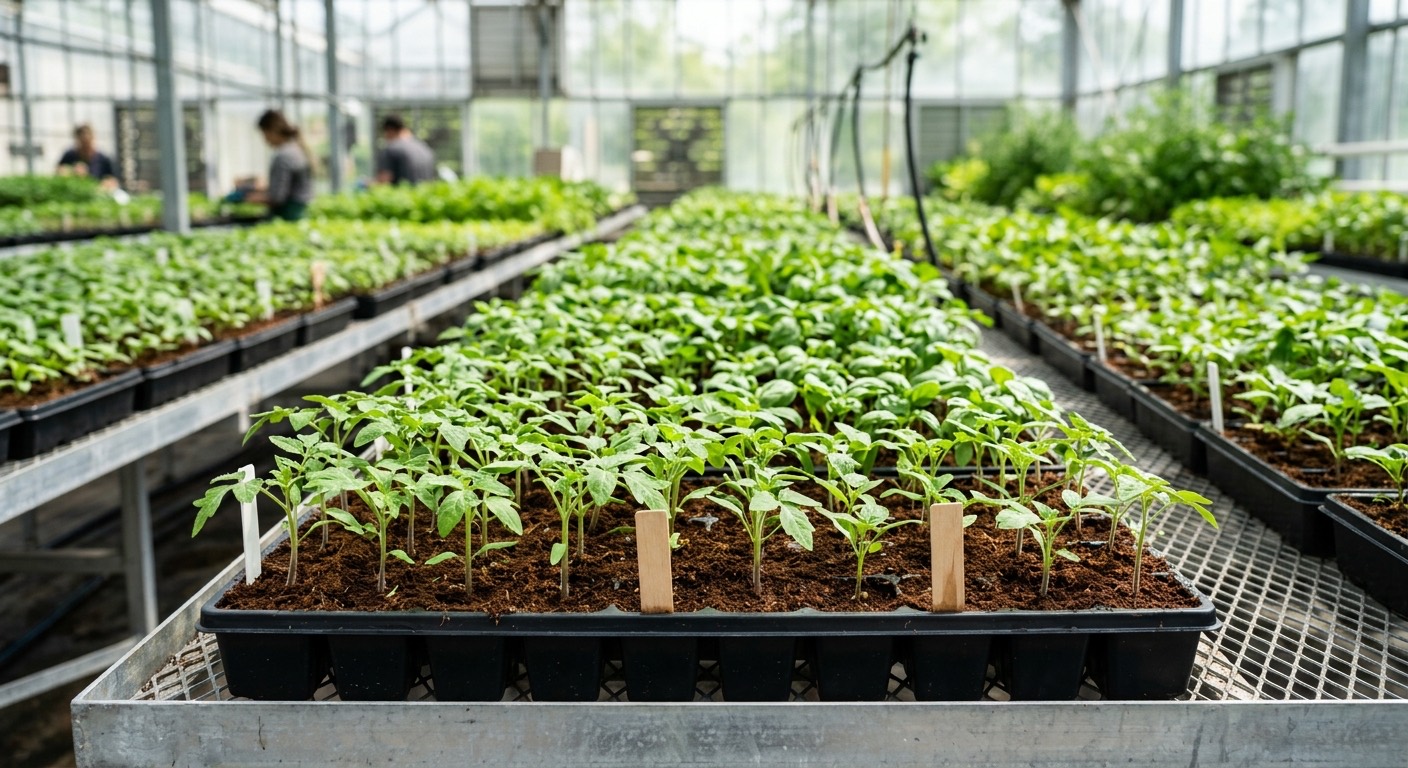
Coir Mix Substrate for Nurseries
A blend of coir pith and coir fiber provides the balanced water retention and aeration that forest and ornamental nurseries need for seedling production in tubetes and containers. The pith fraction retains moisture between irrigation cycles while the fiber fraction maintains air-filled porosity for root development — preventing the compaction that pure pith can suffer in small-volume containers. Produced from dry mature coconut husk in Ceará, Brazil, never retted.
Why coir mix works for nursery seedling production
Nursery seedling production in tubetes (50–280 ml conical tubes) and small containers imposes a specific physical challenge on any substrate: the small volume means the medium must hold enough water to bridge irrigation intervals (often only overhead misting, 2–4 times daily) while maintaining enough air-filled porosity to prevent root hypoxia in a container with no lateral drainage path. Pure coir pith excels at retention but tends to settle and compact in the confined space of a tubete, progressively closing air pores as the seedling grows. Pure fiber drains freely but dries too fast for the small volumes involved.
A pith-fiber blend solves this by distributing the fiber's rigid structure through the pith's water-holding matrix. The fiber strands act as internal scaffolding that resists compression under the weight of wet pith and the expanding root mass, keeping air channels open from germination through hardening. Water retention of approximately 400 ml/L — intermediate between pure pith (~500) and pure fiber (~300) — matches the irrigation frequency of standard nursery misting systems without requiring the constant moisture monitoring that a pure-pith fill would demand in small containers.
For forest nurseries producing eucalyptus, pine, teak or native species at scale (thousands to millions of seedlings per cycle), substrate consistency lot to lot is as important as the physical profile itself. Carve's never-retted origin — dry-farmed husks from the Ceará coast, mechanically processed without soaking in brackish water — gives the mix a natural EC of 0.8–1.5 mS/cm (1:5), a range that most forest species tolerate without issue and that stays predictable across lots because there is no variable retting step adding uncontrolled salt loading.
Technical specification
Values are measured and printed per lot; the QR code on every bag links to the full lab report.
| Parameter | Carve Coir Mix — Nurseries |
|---|---|
| Composition | Blend of coir pith + coir fiber, proportion adjustable per nursery specification (typical 60:40 to 70:30 pith:fiber for tubetes) |
| Raw material | Mesocarpo of dry mature coconut husk (Cocos nucifera L.), Ceará coast, dry-farmed groves, never retted |
| Process | Mechanical shredding, screening and blending; no chemical additives |
| Water retention | ~400 ml/L (adjustable with blend ratio; higher pith = more retention) |
| Total porosity | >94% |
| EC (1:5 v/v) | Natural grade: 0.8–1.5 mS/cm; Washed grade available for sensitive species. Measured per lot. |
| pH | Reported per lot; typical range 5.5–6.5 |
| Moisture at dispatch | Guaranteed ≤18% |
| Bulk density | ~90–110 kg/m³ |
| Organic matter | ≥85% |
| Packaging | 100 L woven bag, lot QR code linking to lab report + origin data |
Control per lot
Every lot is analysed before dispatch. EC, pH and moisture are printed on the bag and linked via QR code to the full bench-test report. Lot-to-lot consistency matters at nursery scale.
Step by step
- Select the pith-to-fiber ratio for your container format: 60:40 to 70:30 for standard tubetes (50–120 ml); higher pith for larger containers (280 ml+ citrus tubes, 1–3 L bags) where compaction risk is lower.
- Check the printed lot EC. Natural grade (0.8–1.5 mS/cm) is suitable for eucalyptus, pine, teak and most native forest species. Request Washed grade for salt-sensitive ornamental seedlings.
- Pre-wet the mix to field capacity before filling tubetes. Dry coir pith resists initial wetting; thorough pre-hydration ensures uniform moisture distribution in every tube.
- Fill tubetes or containers using standard nursery filling equipment. The mix flows well through mechanical fillers; the fiber fraction prevents bridging and ensures consistent fill density.
- Sow or transplant into the filled containers. The pith-fiber blend supports good seed-to-substrate contact for direct sowing and stable plug placement for transplants.
- Irrigate via overhead misting at the nursery's standard schedule. The mix's intermediate retention (~400 ml/L) bridges typical 4–6 hour irrigation intervals without waterlogging.
- Fertigate per the nursery's seedling nutrition program. The per-lot EC report provides a known baseline, so nutrient dosing can be calculated precisely without guessing the substrate's salt contribution.
- Monitor root colonization at the scheduled hardening stage. Well-aerated substrate produces a root plug that holds together when extracted from the tubete — a quality indicator for field transplant survival.
The data behind this application
- ~400 ml/Lwater retention of the default nursery blend — enough to bridge standard misting intervals without waterlogging.
- >94%total porosity, supporting both water retention and air-filled porosity for root development.
- 0.8–1.5 mS/cmnatural-grade EC (1:5) — tolerated by eucalyptus, pine, teak and most native forest species without issue.
- 50–280 mlstandard tubete volume range for forest seedling production — a container format where substrate physics are critical.
- ≤18%moisture at dispatch — stable shelf life and lower shipping weight for nurseries ordering in bulk.
- 100 Lwoven bag with per-lot QR code — lot traceability that scales from pilot batches to million-seedling operations.
What this product does not do
Coir mix provides physical structure and water management, not nutrition — all seedling nutrition must come through the nursery's fertigation program. The natural-grade EC of 0.8–1.5 mS/cm is adequate for most forest species, but nurseries producing salt-sensitive ornamental seedlings (certain palm species, some native epiphytes) should request washed grade or conduct a germination trial before committing to a production run. The blend ratio affects performance in a given container format — a ratio optimized for 120 ml tubetes may not be optimal for 3 L bags, and nurseries switching container formats should test the adjusted ratio before scaling. Coir mix does not suppress damping-off or other seedling diseases; standard nursery hygiene and fungicide protocols remain necessary. In nurseries with very low-frequency irrigation (once daily or less), the intermediate retention of a standard mix may not maintain adequate moisture in small tubetes — higher pith ratios or more frequent misting may be needed.
Carve's product for this application
Carve's Coir Mix for nurseries is produced from mature coconut husks grown in irrigated groves on the Ceará coast, Brazil, and mechanically processed at the Paraipaba-CE plant. The husks are never retted — never soaked in brackish or tidal water, which is the standard fiber-extraction process in India and Sri Lanka and which loads sodium, chloride and other salts into the husk tissue. Asian retted coir can reach raw EC values up to 11.25 mS/cm (1:5 extract), requiring extensive washing before use as a growing medium. Carve's dry-husk origin produces a natural-grade EC of 0.8–1.5 mS/cm — low enough for most forest nursery applications without washing, and predictable lot to lot because there is no variable retting step. The pith-to-fiber ratio is adjustable per order to match the nursery's container format, species and irrigation system. Every 100 L bag ships with a QR code linking to the lot lab report showing EC, pH, moisture and processing date. For related products see Coir Pith, Coir Fiber and Coir Mix; for export logistics see Import Coir from Brazil.
References
- [1] Carve internal specification — coir mix composition, adjustable pith:fiber ratio, per-lot EC/pH testing, 100 L bag packaging.
- [2] Raviv, M. & Lieth, J.H. (eds.), Soilless Culture: Theory and Practice, 2nd ed. — coir pith water-holding capacity, total porosity, air-filled porosity in container substrates.
- [3] Carve internal composition analysis (EMBRAPA Tabela 1, Tabuleiros Costeiros 2005) — inherent mineral content of dry coconut husk, theoretical EC range.
- [4] Raviv Table 8.6, 2nd ed., p. 318, citing Ross et al. 2010/2012 — raw retted coir EC ranges up to 11.25 dS/m, retting process description.
- [5] Carve internal research — coir mix water retention interpolation, tubete filling characteristics, nursery-scale consistency requirements.
Frequently asked questions
Why use coir mix instead of pure pith or pure fiber for nursery seedlings?
Pure coir pith maximizes water retention but can compact in small containers (tubetes), reducing root aeration during the critical early growth phase. Pure fiber provides excellent drainage but dries too quickly for the small substrate volumes in nursery containers. A pith-fiber mix gives the intermediate physical profile that nursery production needs: enough retention to maintain moisture between irrigation cycles, enough aeration to support vigorous root development without waterlogging.
What pith-to-fiber ratio works best for tubetes and nursery containers?
For standard 50–120 ml tubetes, a 60:40 to 70:30 pith-to-fiber ratio provides a good balance of retention and aeration. Larger containers (280 ml+ citrus tubes, 1–3 L bags) can accommodate higher pith ratios since their greater substrate volume reduces compaction risk. Carve adjusts the blend to the nursery's container format and irrigation frequency.
Is natural-grade coir mix (0.8–1.5 mS/cm) safe for forest seedlings?
Most forest species — eucalyptus, pine, teak, native Atlantic Forest seedlings — tolerate the natural-grade EC range of 0.8–1.5 mS/cm (1:5 extract) without issue. These are robust species bred or selected for field conditions far less controlled than a nursery. For sensitive ornamental seedlings or species with documented salt sensitivity, washed grade is available.
How does Carve's never-retted coir differ from Asian coir used in nurseries?
Most Asian coir originates from husks retted (soaked) in brackish or tidal water, which loads sodium and chloride into the material. Raw retted coir can reach EC values up to 11.25 mS/cm (1:5). Carve's husks are dry-farmed on the Ceará coast and never retted, so the natural EC of 0.8–1.5 mS/cm reflects only the coconut's inherent minerals — a lower, more predictable starting point for nursery substrates.
Can coir mix replace vermiculite or perlite in nursery substrates?
Coir mix can partially or fully replace vermiculite and perlite in many nursery formulations. The fiber fraction provides structural aeration similar to perlite, while the pith fraction provides water retention similar to vermiculite. This substitution reduces dependence on mined mineral amendments and often lowers substrate cost per seedling at scale.