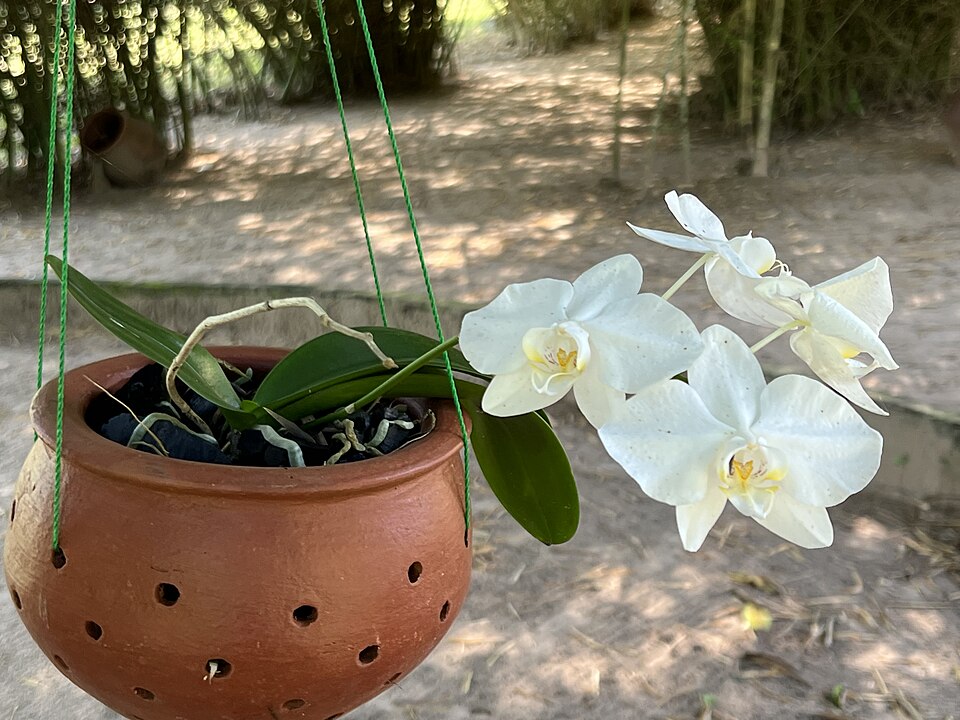
Coir Fiber Substrate for Orchid Potting
Washed coir fiber is the minimum acceptable grade for orchid potting, with Buffered grade recommended for professional Phalaenopsis production, because orchids are typically grown with rainwater irrigation that provides little natural buffering against coir's potassium and sodium reservoir, and root-tip necrosis from K/Na exposure is documented in the species [1]. Carve's fiber, 10-40 cm long and screen-retained (~4.1 mm), provides the open, epiphyte-appropriate air structure orchids need at the pot's macropore scale, distinct from the fine pith used for tube seedlings [2].
The agronomic and physical case
Orchids are epiphytes in their natural growth habit — in the wild, most commercially grown genera (Phalaenopsis, Cattleya, and others in the Brazilian ornamental trade) grow attached to tree bark or branches, not rooted in soil, with roots exposed to air and only briefly wetted by rain before drying out again [1][3]. Potting media for orchids has to replicate this air-exposed, fast-draining, intermittently-wet root environment rather than the moisture-retentive profile appropriate for a terrestrial plant — which is precisely why fiber, not fine pith, is the coir format used for orchid substrate: fiber's structural, open architecture creates the large air-filled pore space (40-60% in the literature for pure fiber) that orchid roots require, while fine pith's much higher water retention (500+ ml/L) would keep orchid roots wet far longer than their physiology tolerates, risking root rot [4][5].
The salinity dimension is where orchid substrate diverges sharply from most other coir applications in this content set, and the reason is specific to how orchids are typically irrigated. Commercial orchid operations, and especially hobbyist growers, very commonly use rainwater or reverse-osmosis water rather than municipal or well water with significant mineral hardness — deliberately, because orchids are sensitive to mineral buildup in general. But this creates a specific problem for unbuffered coir: hard tap water naturally carries calcium and magnesium that can passively displace some of coir's bound potassium and sodium over time, in effect accidentally providing a mild buffering action. Rainwater and RO water have essentially none of that natural calcium/magnesium background, so any coir potassium/sodium release under rainwater irrigation goes largely unmitigated, reaching the root zone directly [1]. Root-tip necrosis from potassium and sodium exposure has been specifically documented in Phalaenopsis, the most widely commercially propagated orchid genus, which is why professional Phalaenopsis operations are advised toward Buffered grade rather than Washed [1][6]. Hobby growers using hard tap water sometimes get away with unbuffered coir precisely because their water chemistry is doing unintentional buffering work that a professional rainwater-fed greenhouse operation does not have.
Technical specification
Values are guarantees measured and printed per lot; the QR code on every bag links to the full bench-test report.
| Parameter | Carve Fibra de Coco — Orchid grade |
|---|---|
| Raw material | Fiber from the mesocarpo of dry mature coconut husk (Cocos nucifera L.), Ceará coast, dry-farmed groves, never retted; screen-retained fraction (~4.1 mm screen), raw, not combed |
| Fiber length | 10-40 cm, natural long fiber, no cutting |
| Recommended grade | Washed (minimum) for hobby/amateur use with mineral-hard tap water; Buffered recommended for professional Phalaenopsis and rainwater/RO-irrigated operations |
| Moisture at dispatch | Guaranteed ≤18% |
| Bulk density (loose) | ~55-80 kg/m3, lot-specific value provided |
| Water-holding capacity | ~300 ml/L — the lowest of the Carve line, appropriate for epiphyte root aeration |
| Air-filled porosity | High relative to pith; literature range for pure fiber 40-60% |
| Total porosity | >94% |
| Lignin content | 35-45% (supports multi-year durability, relevant given typical multi-year orchid repotting cycles) |
| CE / pH | Measured per lot; Washed target <1.0 mS/cm, Buffered target <0.5 mS/cm with K/Na limits comparable to RHP-style specifications |
| Format | Pressed bales for transport, or smaller volumes on request for specialty/hobby-scale buyers |
Control per lot
Every lot is analysed before dispatch. Lots outside the agreed range are held back.
Step by step
- Assess your irrigation water source before selecting grade — hard tap water (with meaningful calcium/magnesium content) provides some natural buffering and may tolerate Washed grade; rainwater or RO-irrigated operations should specify Buffered grade.
- For professional Phalaenopsis production specifically, default to Buffered grade regardless of water source, given the documented sensitivity of the genus to K/Na root-tip exposure.
- Rinse fiber briefly before potting even when using Washed or Buffered grade, as a standard orchid-potting hygiene practice independent of the EC specification.
- Pot loosely, preserving the open, airy structure that gives fiber its aeration advantage — orchid potting should never be compacted the way a pith-filled tray or tubete would be.
- Water on an orchid-appropriate wet-dry cycle (thorough watering followed by near-complete drying at the root zone), which is the correct irrigation pattern for fiber-based epiphyte substrate regardless of grade.
- Monitor root tips periodically for necrosis or discoloration, especially during the first cycle with a new substrate lot, as an early indicator of K/Na stress if grade or water chemistry assumptions were mismatched.
- Replace substrate on your standard orchid repotting cycle (commonly every 1-2 years for many genera); coir fiber's multi-year durability supports this without premature structural breakdown, though salts can still accumulate in older substrate over repeated fertigation cycles even at Buffered grade.
The data behind this application
- ~1,000 t/yrestimated Brazilian demand for coir fiber/chips in professional orchid substrate [1].
- 7.8 million pots/yrapproximate scale of Brazil's Holambra orchid production cluster, the country's largest commercial orchid grower base [1].
- 1-3 yearstypical orchid substrate service cycle before repotting [1].
- 40-60%air-filled porosity range for pure fiber in the literature, versus roughly 10-15% for fine pith, the physical basis for choosing fiber over pith in orchid substrate [4][5].
- 300 ml/LCarve fiber's water-holding capacity, the lowest across the Carve product line and appropriate for epiphyte root drying cycles [2].
What this product does not do
Buffered-grade fiber addresses the delayed-release potassium/sodium mechanism but does not eliminate every orchid cultivation risk — overwatering, poor air circulation, and fungal/bacterial pathogens remain independent risk factors that substrate grade does not address. Coir fiber's durability (multi-year, lignin-supported) is an advantage for repotting-interval planning, but salts can still accumulate in substrate over repeated fertigation cycles even at Buffered grade, particularly under hard or moderately saline irrigation water, so periodic leachate testing remains good practice regardless of starting grade. Hobby growers using genuinely hard tap water may find Washed grade performs adequately without the added cost of Buffered, but this is water-chemistry-dependent and should not be assumed without testing your specific water source — the buffering effect of tap-water calcium/magnesium is real but variable by region. Fiber alone does not replicate every aspect of bark or sphagnum moss substrate performance for every orchid genus; growers switching substrate types for the first time should expect an adjustment period and should not assume identical watering frequency across substrate types.
Carve's product for this application
Carve's Fibra de Coco for orchid substrate is produced from the mesocarpo of dry mature coconut husk grown in irrigated coconut groves on the Ceará coast, never retted in brackish or tidal water, and irrigated with low-conductivity well water (64-480 µS/cm) — a meaningful starting-point advantage for a use case this sensitive to potassium and sodium exposure. Asian raw coir, particularly where retting in ponds or tidal water is part of standard processing, has been documented at EC levels as high as 11.25 dS/m raw, and even commercial washed sources in the literature span 0.12-2.9 dS/m depending on processing rigor — a wide, unpredictable range for a crop where root-tip necrosis from excess K/Na is a documented failure mode [6][7]. Carve's own composition analysis (K 1.60%, Na 0.38%, Cl 1.80% dry mass) sets a theoretical EC ceiling of only 1.0-1.5 mS/cm before washing, meaning even Carve's Washed grade starts from a lower, more controllable baseline than much of the internationally sourced material a Brazilian orchid grower might otherwise import [8]. Carve also offers Buffered grade (wash plus a Ca(NO3)2 soak step displacing bound K/Na with calcium) for professional Phalaenopsis operations and rainwater-irrigated growers — ask your Carve contact about current Buffered fiber availability and lead times. Every bale carries lot documentation accessible via QR code, covering EC, pH, moisture and origin. For related applications, see /en/products/coir-pith-ornamental-flowers and /en/products/coir-fiber-mattress-pads; for the full fiber line see /en/products/coir-fiber; for export questions see /en/import-coir-from-brazil.
References
- [1] Carve internal research, `coir-products-use-cases-grades-2026-09-01.md` §3.1/§3.3 — orchid segment sizing, Holambra cluster scale, root-tip necrosis documentation, Buffered-grade recommendation, hobby-grower hard-water exception.
- [2] Carve internal specification, `mvp-product-specs.md` §3a — fiber length, water-holding capacity, bulk density.
- [3] General orchid horticulture literature on epiphytic growth habit and root physiology.
- [4] Raviv, M. & Lieth, J.H. (eds.), Soilless Culture: Theory and Practice, 2nd ed., Table 8.5, p. 317 — coir pith AFP 9.5-57.8% by origin, contrasted with pure-fiber literature range.
- [5] Carve internal research, `coir-products-use-cases-grades-2026-09-01.md` §1.3 — fiber air-filled porosity 40-60% (literature), vs pith 10-15%.
- [6] Raviv Table 8.6, 2nd ed., p. 318 — commercial washed coir EC range 0.12-2.9 dS/m; raw Tamil Nadu east-coast EC up to 11.25 dS/m.
- [7] Raviv, M. & Lieth, J.H. (eds.), Soilless Culture: Theory and Practice, 2nd ed., Ch. 8, p. 314 — buffering process description (Ca(NO3)2 treatment, 'buffered coir').
- [8] Carve internal composition analysis (EMBRAPA Tabela 1, Tabuleiros Costeiros 2005) — K 1.60%, Na 0.38%, Cl 1.80%; theoretical EC ceiling, `mvp-product-specs.md` §2.
Frequently asked questions
What grade of coir fiber is best for orchids?
Buffered grade is recommended for professional Phalaenopsis production and for any rainwater- or RO-irrigated operation, since those water sources provide no natural calcium/magnesium buffering against coir's potassium/sodium reservoir. Washed grade can be adequate for hobby growers using hard tap water [1].
Why does irrigation water source matter for orchid substrate grade selection?
Hard tap water contains calcium and magnesium that can passively displace bound potassium and sodium in coir, providing accidental buffering. Rainwater and reverse-osmosis water lack this mineral background, so unbuffered coir's salt release reaches orchid roots largely unmitigated [1].
Why is fiber used for orchids instead of fine coir pith?
Orchids are epiphytes that need a fast-draining, highly air-permeable root environment, not the moisture-retentive profile pith provides. Fiber's open structure delivers air-filled porosity in the 40-60% range, versus roughly 10-15% for fine pith [4][5].
What happens if orchids are potted in unbuffered, unwashed coir?
Root-tip necrosis from potassium and sodium exposure has been documented in Phalaenopsis, the most widely commercially grown orchid genus, making Natural-grade coir a real risk for this crop without further processing [1][6].
How often should orchid coir substrate be replaced?
Typically every 1 to 2 years, a shorter cycle than fiber's underlying multi-year structural durability would allow on its own, because salts and mineral buildup can accumulate in the substrate over repeated fertigation even at Buffered grade [1].